
Half Plan and Half Elevation for a Catafalque for Margarita Louisa, Gran Duchess of Tuscany (d. 1721)
ca. 1721
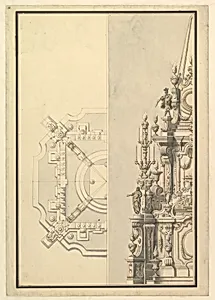
Medium
Pen, brown ink and gray and yellow washes
Dimensions
20-3/8 x 14-1/4 in. (51.8 x 36.2 cm)
Classification
Drawings
Department
Drawings and Prints
Museum
Metropolitan Museum of Art, New York, NY
Credit
Purchase, Bequest of Joseph H. Durkee, by exchange, 1972
Accession Number
1972.713.11
Rights
Public Domain
Tags
Art Historical Context
This intricate architectural drawing by Giuseppe Galli Bibiena a master of the Bibiena family dynasty renowned for their innovative Baroque stage designs and scenic architecture, depicts a "Half Plan and Half Elevation for a Catafalque" honoring Margarita Luisa, Grand Duchess of Tuscany, who passed away in 1721. Created around that year, the work exemplifies the theatrical grandeur of early 18th-century European funerary art, blending architecture with dramatic illusionism—a hallmark of the Bibienas' style, which influenced opera houses and court spectacles across Italy and beyond. The catafalque, a temporary bier or ornate structure used in noble funerals, reflects the opulent rituals of the Medici court in Tuscany. Margarita Luisa d'Orléans, a French princess married into the powerful Medici family, merited such elaborate designs to symbolize her status and the era's fusion of mourning with magnificence. Bibiena's precise rendering captures both a top-down plan and a side elevation, offering a blueprint for a monumental temporary edifice likely adorned with columns, drapery, and symbolic motifs. Executed in pen with brown ink and subtle gray and yellow washes on paper (20-3/8 x 14-1/4 in.), the drawing employs washes for depth and luminosity, mimicking the chiaroscuro effects of grand architecture. Housed in the Metropolitan Museum of Art's Drawings and Prints department, it invites visitors to appreciate how such preparatory sketches bridged design and spectacle in the Baroque age.
About the Artist
Giuseppe Galli Bibiena · 1696–1757
Giuseppe Galli Bibiena was born on January 5, 1696, in Parma, into what would become the most celebrated dynasty of theatrical designers in Baroque Europe. He was the second son of Ferdinando Galli Bibiena, who was himself a transformative figure in stage design and the originator of the family's defining innovation: the scena per angolo, or "scene viewed at an angle." This technique replaced the ...