
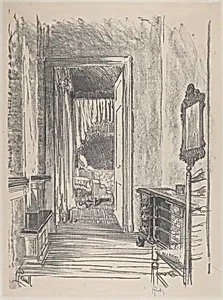
Hallway to Bed Room, Stenton
1912
Medium
lithograph
Classification
Department
CG-W
Museum
National Gallery of Art, Washington, D.C.
Credit
Rosenwald Collection
Accession Number
1943.3.6790
Rights
Public Domain
Art Historical Context
Step into the elegant interior of Stenton, a historic 18th-century mansion in Philadelphia, through Joseph Pennell's captivating 1912 lithographHallway to Bed Room Stenton*. Pennell a prominent American printmaker and illustrator (1857–1926), was renowned for his meticulous documentation of architectural treasures, blending fine art with preservationist zeal. This print captures the gracious Georgian hallway leading to the bedroom, evoking the refined domestic life of James Logan, Pennsylvania's colonial secretary who built Stenton in 1759. As a lithograph—a planographic printing process Pennell mastered— the work showcases his virtuoso use of crayon on stone to achieve rich tonal gradations and subtle textures. Light filters dramatically through the space, highlighting wood paneling and architectural details with an atmospheric depth that rivals his famous urban scenes. Pennell's style, rooted in the late 19th-century etching revival, emphasized authenticity over embellishment, making his prints invaluable records of vanishing Americana. Housed in the National Gallery of Art's Rosenwald Collection, this piece reflects early 20th-century interest in colonial revival amid rapid urbanization. It invites visitors to appreciate not just the artistry, but Stenton's enduring legacy as a touchstone of American history.
About the Artist
Joseph Pennell · 1857–1926
Joseph Pennell (1857–1926) was born in Philadelphia to Quaker parents and displayed an early aptitude for drawing, finding solace in sketching amid a challenging childhood. He received initial drawing instruction from James R. Lambdin and his first etching lessons from Stephen Ferris in 1879. Pennell attended night classes at the Pennsylvania Museum and School of Industrial Art before studying at ...