
Hama-yumi and Buriburi-gitcho; Both Ceremonial Toys of Boys for the New Year
19th century
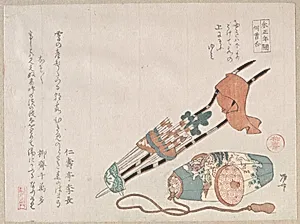
Medium
Part of an album of woodblock prints (surimono); ink and color on paper
Dimensions
5 1/2 x 7 7/16 in. (14 x 18.9 cm)
Classification
Prints
Culture & Period
Japan · Edo period (1615–1868)
Department
Asian Art
Museum
Metropolitan Museum of Art, New York, NY
Credit
H. O. Havemeyer Collection, Bequest of Mrs. H. O. Havemeyer, 1929
Accession Number
JP2263
Rights
Public Domain
Tags
Art Historical Context
In the vibrant world of Edo-period Japan (1615–1868), Ryūryūkyo Shinsai crafted this delightful woodblock print as part of a *surimono* albumintimate, privately commissioned prints often shared among poetry circles during celebrations like the New Year.itled *Hama-yumi and Burib-gitcho; Bothemonial Toys of Boys the New Year*, the small-scale work (5 1/2 x 7 7/16 in.) captures two traditional playthings: the *hama-yumi*, a toy bow and arrow symbolizing youthful aspirations for martial prowess, and the *buriburi-gitcho*, a noisemaking drum evoking festive joy. Rendered in vivid ink and color on paper, it reflects *ukiyo-e* traditions, where everyday customs blend with artistic finesse. These toys held deep cultural resonance, gifted to boys during *oshōgatsu* (New Year's) to invoke good fortune, strength, and prosperity in the coming year—a nod to Confucian ideals of filial duty and samurai heritage amid Japan's peaceful Edo era. Shinsai's mastery shines in the precise woodblock technique, layering colors for luminous effects and fine details that bring the toys to life, as if ready for a child's grasp. Now housed in the Metropolitan Museum of Art's Asian Art Department (H. O. Havemeyer Collection, 1929), this print offers a window into Japan's playful rituals, reminding us how art preserved fleeting moments of cultural delight.
About the Artist
Ryūryūkyo Shinsai · 1799–1823
Ryūryūkyo Shinsai (柳々居辰斎), active from 1799 to 1823, was a prominent Japanese ukiyo-e printmaker based in Edo (modern Tokyo), renowned for his mastery of surimono—luxurious, privately commissioned woodblock prints produced for elite poetry circles and New Year's celebrations. He began his training under Tawaraya Sōri before becoming a student of the legendary Katsushika Hokusai, from whom he recei...