
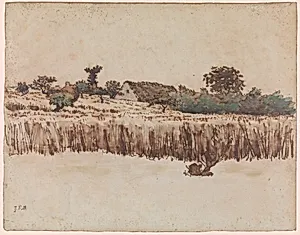
Hamlet in a Wheat Field, Vichy
Medium
Pen and brown ink, with brush and brown wash, and watercolor
Dimensions
Sheet: 8 1/8 × 10 7/16 in. (20.6 × 26.5 cm)
Classification
Drawings
Department
Drawings and Prints
Museum
Metropolitan Museum of Art, New York, NY
Credit
Bequest of Nanette B. Kelekian, 2020
Accession Number
2021.28.1
Rights
Public Domain
Tags
Art Historical Context
Jean-François Millet’s *let in a Wheat Field, Vichy* captures a quiet rural moment from 1867, when the artist was at the height of his career depicting the French countryside. As a leading figure of the Barbizon School and a pioneer of Realism, Millet turned away from grand historical subjects to celebrate the everyday beauty of peasant life and working landscapes. This small drawing likely records a scene near the spa town of Vichy, where Millet traveled for health reasons, transforming an ordinary view into a meditation on harmony between people and nature. Executed in pen and brown ink with brush, wash, and touches of watercolor, the work demonstrates Millet’s mastery of mixed media on paper. The layered brown tones and delicate watercolor accents create a luminous, earthy atmosphere that conveys both the warmth of summer and the textures of wheat and village rooftops. At just over eight by ten inches, the sheet rewards close looking, revealing Millet’s sensitive line work and his ability to suggest vast space within a modest format. Now part of the Metropolitan Museum’s collection of drawings and prints, this piece offers visitors an intimate glimpse into Millet’s working process and his enduring fascination with the French rural world during a period of rapid modernization.
About the Artist
Jean-François Millet · 1814–1875
Jean-François Millet (1814-1875) was a French painter and one of the founders of the Barbizon school, whose dignified depictions of peasant laborers transformed how art could represent rural life. His monumental images of sowers, gleaners, and field workers elevated common people to subjects previously reserved for mythological or historical figures, making him a pivotal figure in the development ...