
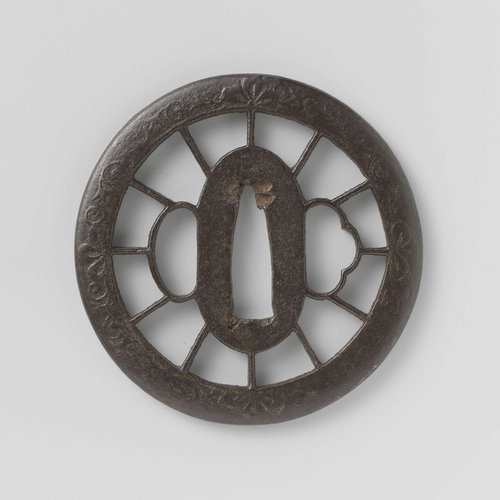
Hand guard
1600 - 1699
Medium
iron (metal)
Dimensions
7.1; 7.2
Rights
Public Domain
About this artwork
Bruikleen van de Koninklijke Vereniging van Vrienden der Aziatische Kunst (legaat Westendorp-Osieck, 1968)
Art Historical Context
This delicate iron hand guard, crafted anonymously between 1600 and 1699, measures just 7.2 cm high by 7.1 cm wide—small yet robust, hinting at its practical role in protecting the hand during combat. Forged from iron, a durable metal prized for its strength and workability in Asian metalworking traditions, it exemplifies the fusion of utility and artistry common in 17th-century. Such guards were essential components of weaponry or armor, shielding warriors while allowing fluid movement. Dating to the early Edo period in Japan—a time of relative peace following centuries of civil war—these objects evolved from purely functional pieces into symbols of status and refinement. Artisans employed sophisticated techniques like piercing, hammering, and patination to create intricate designs, though this example's specifics remain shrouded in anonymity. Its presence in an Asian art collection underscores the cultural reverence for martial arts, where even protective gear reflected philosophical ideals of harmony between form and function. Today, this hand guard is on loan (bruikleen) from the Koninklijke Vereniging van Vrienden der Aziatische Kunst, part of the 1968 Westendorp-Osieck bequest. It invites us to ponder the lives of unseen craftsmen whose work bridged war and peace, reminding visitors of Asia's rich legacy in metallurgical innovation.
About the Artist
anonymous
In the vast tapestry of art history, "Anonymous" stands not as a singular individual but as a collective designation for countless unidentified creators whose works have endured across millennia. These artists, spanning prehistoric cave painters to medieval illuminators and folk craftsmen, produced the foundational layers of human visual culture. Prior to the Renaissance, when individual fame emer...