
Hand guard
1600 - 1900
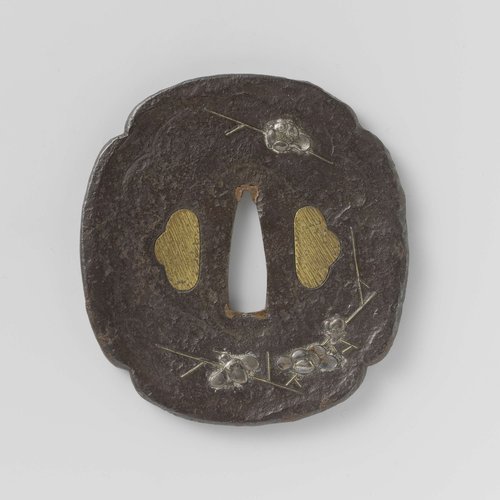
Medium
iron (metal)
Dimensions
7.5; 8.1
Rights
Public Domain
About this artwork
…; collection of Herman Karel Westendorp (1868-1941), Amsterdam, 1941;{Note RMA.} his widow Betsy Westendorp-Osieck (1880-1968), Amsterdam, by whom bequeathed to the Vereniging van Vrienden der Aziatische Kunst, 1968;{note RMA.} from whom on loan to the museum, 1972
Art Historical Context
This delicate iron hand guard, crafted between 1600 and 1900, exemplifies fusion of utility and artistry in historical weaponry. Measuring just 8.1 cm in height and 7.5 cm in width, its compact form was designed to shield the wielder's hand from blows during combat, likely as part of a sword hilt. Forged from sturdy iron, the medium allowed for intricate techniques like piercing, hammering, and surface texturing, balancing strength with potential decorative flair—common in arms from East Asia, as suggested by its provenance. Acquired by Amsterdam collector Herman Karel Westendorp (1868–1941), the piece passed to his widow, Betsy Westendorp-Osieck (1880–1968), before being bequeathed in 1968 to the Vereniging van Vrienden der Aziatische Kunst (Association of Friends of Asian Art). It has been on loan to the museum since 1972, reflecting early 20th-century European enthusiasm for Asian metalwork. Such guards hold cultural significance as emblems of martial heritage, possibly linked to samurai traditions or regional warfare, where every component embodied skilled craftsmanship and warrior ethos. Though modest in scale, this hand guard invites us to ponder the lives of its unseen makers and users, preserving a tangible link to centuries of conflict and ingenuity.
About the Artist
anonymous
In the vast tapestry of art history, "Anonymous" stands not as a singular individual but as a collective designation for countless unidentified creators whose works have endured across millennia. These artists, spanning prehistoric cave painters to medieval illuminators and folk craftsmen, produced the foundational layers of human visual culture. Prior to the Renaissance, when individual fame emer...