
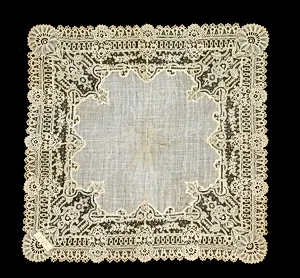
Handkerchief
Unknown Artist
fourth quarter 19th century
Medium
Linen
Classification
Handkerchief
Culture
Belgian
Department
Costume Institute
Museum
Metropolitan Museum of Art, New York, NY
Credit
Brooklyn Museum Costume Collection at The Metropolitan Museum of Art, Gift of the Brooklyn Museum, 2009; Gift of Sallie Hodges, 1924
Accession Number
2009.300.4079
Rights
Public Domain
Art Historical Context
This delicate linen handkerchief, created by an unknown Belgian artist in the fourth quarter of the 19th century (1876–1900), invites visitors to the Costume Institute to appreciate the understated elegance of everyday Victorian-era accessories. Linen, a natural fiber derived from flax, was highly valued for its softness, durability, and breathability, making it ideal for personal items like handkerchiefs carried in pockets or purses. In late 19th-century Belgium, a hub of fine textile production, such handkerchiefs served both practical and ornamental purposes, often accompanying elaborate fashions. Though simple in form, this piece reflects the craftsmanship of Belgian linen weaving traditions, which emphasized purity and precision. Its preservation highlights how ordinary objects captured the era's social norms, where even handkerchiefs could signify refinement. Acquired as part of the Brooklyn Museum Costume Collection (gift of Sallie Hodges, 1924) and transferred to The Metropolitan Museum of Art in 2009, it stands as a tangible link to personal histories, reminding us of the intimate role textiles played in daily life.