
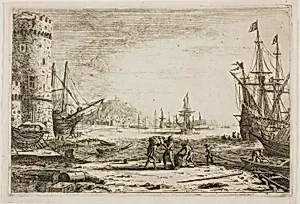
Harbor with a Large Tower
c. 1641
Medium
Etching on ivory laid paper
Dimensions
Image: 12.8 × 18.9 cm (5 1/16 × 7 1/2 in.); Plate: 13 × 19.2 cm (5 1/8 × 7 9/16 in.); Sheet: 13.8 × 20 cm (5 7/16 × 7 7/8 in.)
Classification
etching
Department
Prints and Drawings
Museum
Art Institute of Chicago
Accession Number
111958
Rights
Public Domain
About this artwork
The date for this print can be found etched on the "'sack that rests on the ground and, more distinctly, on the sack held on the shoulders of the man in the foreground.
Art Historical Context
Claude Lorrain's *Harbor with a Large* (c. 1641) captures the artist's masterful vision of an idealized Mediterranean seascape, a hallmark his Classical landscape style. Working primarily in Rome after leaving France, Lorrain drew inspiration from ancient ruins and sunlit harbors, blending real Italian scenery with poetic imagination. This etching depicts a grand tower rising amid bustling ships and distant architecture, bathed in his signature golden light that evokes the calm grandeur of the classical past. As one of Lorrain's rare forays into printmaking—among only a handful of etchings he produced—this work on ivory laid paper showcases etching's precision, where acid etches intricate lines into a metal plate for tonal depth and atmospheric perspective. At just 12.8 × 18.9 cm, the intimate scale invites close viewing, revealing delicate cross-hatching that mimics his oil paintings' luminous effects. These prints helped spread Lorrain's influence across Europe, inspiring generations of Romantic landscapists like Turner. Housed in the Art Institute of Chicago's Prints and Drawings department, this piece highlights 17th-century innovations in reproductive art, bridging painting and print culture while celebrating humanity's harmony with nature. A timeless gem for harbor enthusiasts!
About the Artist
Claude Lorrain · 1604–1682
Claude Lorrain (c. 1600-1682), born Claude Gellée in the village of Chamagne in northeastern France's Duchy of Lorraine, stands as one of the most influential landscape painters in Western art history. Orphaned by age twelve, his journey to artistic mastery was unconventional—beginning with apprenticeships in pastry-making and inlay work before destiny led him to Rome around 1620, where he would s...