
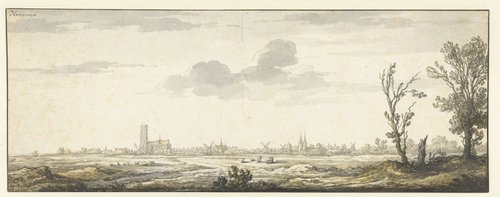
Harderwijk.
c. 1630 - c. 1691
Medium
brush
Dimensions
433; 185
Rights
Public Domain
About this artwork
penseel in grijs, geelgroen en bruin; zwart krijt en Arabische gom
Art Historical Context
Aelbert Cuyp's *Harderwijk*, created sometime between 1630 and 1691, captures the artist's masterful touch in a compact panoramic drawing measuring just 185 mm high by 433 mm wide. As a leading figure of the Dutch Golden Age,yp was renowned for his luminous landscapes bathed in golden light, often featuring rivers, cattle, and Dutch townscapes. This work likely depicts the charming coastal town of Harderwijk on the former Zuiderzee, evoking the serene beauty of 17th-century Netherlands during a prosperous era of trade and exploration. Rendered with brush in subtle tones of gray, yellow-green, and brown, the piece incorporates black chalk for precise lines and gum arabic as a binder to achieve delicate washes. This mixed-media technique highlights Cuyp's skill in preparatory studies, blending the fluidity of watercolor-like effects with the control of chalk—common in Dutch artists' sketchbooks for refining compositions before oil paintings. The earthy palette suggests atmospheric depth, a hallmark of Cuyp's ability to convey expansive skies and watery horizons. Though small in scale, *Harderwijk* offers a window into Cuyp's observational genius, bridging studio practice and plein-air sketching traditions. It reminds us how such modest drawings fueled the grandeur of Golden Age masterpieces, inviting visitors to appreciate the quiet poetry of everyday Dutch vistas.
About the Artist
Aelbert Cuyp · 1620–1691
Aelbert Cuyp (1620–1691), a leading figure of the Dutch Golden Age, was born and died in Dordrecht, Netherlands, where he spent his entire life. The son of portraitist and animal painter Jacob Gerritsz Cuyp (1594–1652), Aelbert came from a family of artists—his uncle Benjamin Gerritsz Cuyp and grandfather Gerrit Gerritsz Cuyp were stained-glass designers—and studied under his father, with whom he ...