
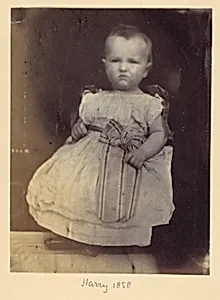
Harry
Medium
Albumen silver print from glass negative
Dimensions
13.8 x 9.9 cm. (5 7/16 x 3 7/8 in.)
Classification
Photographs
Department
Photographs
Museum
Metropolitan Museum of Art, New York, NY
Credit
Gift of Paul F. Walter, in memory of Christopher Hemphill, 1987
Accession Number
1987.1183.63
Rights
Public Domain
Tags
Art Historical Context
In the mid-19th century, as photography emerged as a revolutionary medium, Alfred Capel captured this intimate portrait titled *Harry* in 1858. Rendered as an albumen print from a glass negative, the image measures a modest 13.8 x 9.9 cm, ideal for personal albums or keepsakes. The albumen process, introduced in the 1850s, used egg whites to create a glossy surface that held light-sensitive silver salts, yielding richly toned, finely detailed prints that were the gold standard of the era—far sharper than earlier paper negatives. This poignant photograph depicts a young boy, embodying the Victorian era's growing fascination with childhood portraiture. Photography democratized portrait-making, allowing families beyond the elite to preserve everyday moments. Cure, a British photographer active in the 1850s, exemplifies the technical prowess of early practitioners who mastered glass-plate negatives via the wet collodion method, exposing and developing plates on-site for crisp results. Displayed in the Metropolitan Museum of Art's Photographs Department (gift of Paul F. Walter, 1987), *Harry* offers a window into 19th-century domestic life, reminding us how a simple snapshot can evoke timeless tenderness.
About the Artist
Alfred Capel Cure · 1826–1896
Alfred Capel Cure (1826–1896) was a British artist whose career unfolded during the Victorian era, a period of remarkable diversity and ambition in British art. Active in a landscape tradition shaped by the achievements of John Constable and J.M.W. Turner, Cure worked at a time when watercolor and drawing held an especially prominent place in English artistic culture, embraced both by professional...