
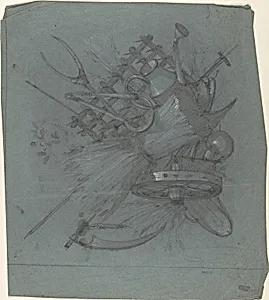
Harvest Trophy
19th century
Medium
Pen and brown ink, brush and brown wash, black chalk, heightened with white. Pricked for transfer.
Dimensions
13 1/16 x 11 5/8in. (33.2 x 29.6cm)
Classification
Drawings
Department
Drawings and Prints
Museum
Metropolitan Museum of Art, New York, NY
Credit
The Elisha Whittelsey Collection, The Elisha Whittelsey Fund, 1963
Accession Number
63.616.15
Rights
Public Domain
Tags
Art Historical Context
"Harvest Trophy" by Charlesblond, a 19th-century preparatory drawing, captures the bountiful essence of the harvest in intricate detail. Created with pen and brown ink, brush and brown, black chalk, and with white gouache, this sheet measures 13 1/16 x 11 5/8 inches. Housed in the Metropolitan Museum of Art's Department of Drawings and Prints as part of The Elisha Whitt Collection (1963), it exemplifies the meticulous draftsmanship of its era. The artwork's pricked edges reveal its practical purpose: it was designed for transfer, a technique where tiny holes along the contours allowed charcoal dust to be pounced through, transferring the composition onto another surface for painting, engraving, or fresco. This method, rooted in Renaissance practices and still vital in the 19th century, underscores Monblond's role in the workshop tradition, bridging preliminary sketches to grander works. The "trophy" format—likely a lavish pile of fruits, grains, and vegetables—evokes classical still-life motifs symbolizing abundance and seasonal cycles, resonating with Romantic-era celebrations of nature's generosity. Monblond's mixed-media approach creates depth and luminosity: the brown wash builds shadowy volumes, while white heightening adds sparkling highlights, inviting viewers to savor the tactile richness of the harvest. A charming window into 19th-century artistic processes, this drawing reminds us how humble sketches fueled enduring visual feasts.
About the Artist
Charles Monblond · 1800–1900
**Charles Monblond**, a French painter and designer born in Paris, flourished during the mid- to late nineteenth century, capturing the ornate spirit of Second Empire decorative arts through his meticulous drawings and paintings. Residing at 9 Rue Marignan, he studied under M. Ch. Polisch, honing skills that blended floral still lifes with architectural ornamentation. In 1866, Monblond sought perm...