
Hasp
1935/1942
Medium
watercolor and pen and ink on paper
Dimensions
overall: 28 x 22.7 cm (11 x 8 15/16 in.)
Classification
Index of American Design
Department
CG-W
Museum
National Gallery of Art, Washington, D.C.
Credit
Index of American Design
Accession Number
1943.8.17694
Rights
Public Domain
Art Historical Context
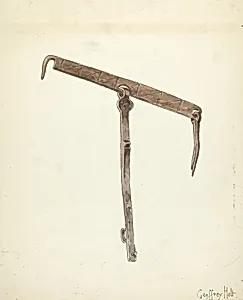
**Hasp** by Geoffrey Holt captures the humble yet elegant beauty of American craftsmanship in a precise watercolor and pen-and-ink rendering on paper, measuring 28 x 22.7 cm. Created between 1935 and 1942, this work depicts a hasp—a functional metal fastening device often found on doors, chests, or gates—highlighted with meticulous detail that reveals its form, texture, and subtle ornamentation. Holt's technique blends the fluidity of watercolor for depth and shading with the sharp lines of pen and ink, creating a lifelike study that elevates everyday hardware to an object of artistic appreciation. This piece is part of the *Index of American Design*, a groundbreaking WPA Federal Art Project from the Great Depression era (1935–1942). Artists across the U.S. documented thousands of folk art objects, tools, and designs to preserve the nation's cultural heritage amid economic hardship. By rendering these items with photographic accuracy and artistic flair, the Index celebrated vernacular creativity, from colonial hardware to Native American crafts, ensuring their legacy for future generations. Today, housed in the National Gallery of Art, *Hasp* reminds us of America's inventive spirit and the skilled hands behind its material culture. It's a testament to how ordinary objects embody history, inviting visitors to notice the artistry in the functional.
About the Artist
Geoffrey Holt · 1855–present
Geoffrey Holt was born in England on August 18, 1882, and received his artistic training in London and Paris before eventually making his career in the United States. After arriving in America, he lived in Minneapolis, where he worked as an interior designer for the John S. Bradstreet Company—an experience that developed his sensitivity to space, surface, and decorative harmony. By around 1920 he ...