
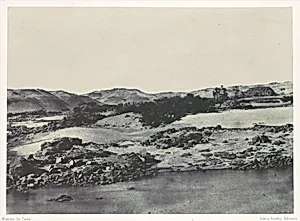
Haute-Égypte. Entrée de la première Cataracte
Medium
Salted paper print (Blanquart-Évrard process) from paper negative
Classification
Photographs
Department
Photographs
Museum
Metropolitan Museum of Art, New York, NY
Credit
Robert O. Dougan Collection, Gift of Warner Communications Inc., 1981
Accession Number
1981.1229.6.10
Rights
Public Domain
Tags
Art Historical Context
In 1850, French writer and pioneering photographer Maxime Du Camp capturedHaute-Égypte. Entrée de la premièreacte*, a stunning salted paper print depicting the dramatic to the Nile River's First Cataract in Egypt. This rugged landscape of rocky outcrops and turbulent waters marked a gateway to ancient Nubia, evoking the timeless allure of pharaonic exploration. Du Camp produced this image during his groundbreaking 1849–1850 expedition with Gustave Flaubert, one of the earliest photographic journeys to document Egypt's monuments and natural wonders for European audiences. Printed using the innovative Blanquart-Évrard process at the Imprimerie photographique in Lille, the work employed a paper negative to create richly toned salted paper prints. Developed by Louis Désiré Blanquart-Évrard, this technique allowed for multiple high-quality reproductions from a single negative—revolutionary in an era when photography was labor-intensive and largely one-of-a-kind. It bridged the gap between daguerreotypes and later albumen prints, democratizing access to exotic imagery. As part of the Metropolitan Museum of Art's Robert O. Dougan Collection, this photograph exemplifies early travel photography's role in shaping Western fascination with the Orient, blending artistic vision with scientific documentation of vanishing landscapes.
About the Artist
Maxime Du Camp|Imprimerie photographique de Blanquart-Évrard, à Lille · 1822–present
Maxime Du Camp (1822–1894) was a pioneering French photographer and writer whose adventurous spirit and technical innovation bridged literature and visual art during the mid-19th century. Born in Paris on February 8, 1822, to a prosperous family—his father a successful surgeon—Du Camp received a solid bourgeois education at the Collège Bourbon (now Lycée Condorcet), where he cultivated interests i...