
Head
1919-1920
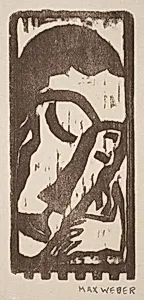
Medium
woodcut in brown on laid paper
Dimensions
image: 10.6 x 4.9 cm (4 3/16 x 1 15/16 in.) sheet: 25.4 x 16.5 cm (10 x 6 1/2 in.)
Classification
Department
CG-W
Museum
National Gallery of Art, Washington, D.C.
Credit
Gift of Jack and Margrit Vanderryn
Accession Number
1997.128.9
Rights
Public Domain
Art Historical Context
Max Weber's *Head* (1919-1920) is a striking woodcut print in brown ink on laid paper, capturing the artist's modernist experimentation during the post-World War I era. Measuring just 10.6 x 4.9 cm in its image area, this intimate work exemplifies Weber's shift toward abstracted forms, influenced by his encounters with Cubism, African sculpture, and European avant-garde movements. As a Russian-born Jewish immigrant who became a pivotal figure in American modernism, Weber bridged European innovation with New York's burgeoning art scene, where he taught and exhibited alongside contemporaries like Stuart Davis. The woodcut technique—carving away wood to leave raised lines for inking—lends *Head* a bold, tactile quality, with the brown tone evoking earthiness and depth on the textured laid paper. This relief method, rooted in traditional printmaking, allowed Weber to distill human features into rhythmic, geometric contours, emphasizing emotional intensity over realism. Produced during a time of cultural upheaval, the print reflects modernism's quest for universal expression amid rapid social change. Now housed in the National Gallery of Art as a gift from Jack and Margrit Vanderryn, *Head* invites visitors to appreciate how Weber's precise craftsmanship transformed simple materials into profound visual poetry, making high art accessible through its modest scale.
About the Artist
Max Weber · 1881–1961
Max Weber (1881–1961), born in Białystok in the Russian Empire (now Poland) to Orthodox Jewish parents, immigrated to Brooklyn, New York, at age ten with his family, joining his tailor father.) There, he pursued art studies at the Pratt Institute under Arthur Wesley Dow, an innovative teacher who emphasized expression and form over traditional narrative, drawing from Japanese art and Paul Gauguin....