
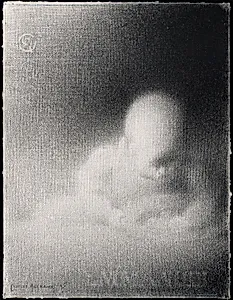
Head of a Child (Emmanuel)
1898
Medium
Black Conté crayon on ivory laid paper, ruled in blue pencil at edges
Dimensions
62.5 × 47.8 cm (24 5/8 × 18 7/8 in.)
Classification
prints and drawing
Department
Prints and Drawings
Museum
Art Institute of Chicago
Accession Number
185811
Rights
Public Domain
About this artwork
The typical relationship between light and dark is reversed in this drawing. A bright, crawling infant, leaning its weight on its forearms, seems to emerge from the shadows. This technique, wherein individual marks give way to a broader, atmospheric effect, was indebted to Georges Seurat, whom Angrand knew well. Although he made his name in Paris, after the death of his father Angrand retreated to his hometown of Saint-Laurent-en-Caux to care for his mother in 1896. This work comes from that per...
Art Historical Context
Charles Angrand's *Head of a Child (Emmanuel)*, created in 1898, the tender innocence of youth through the intimate gaze of a young boy. As a French Neo-Impression artist closely associated with Paul Signac and Henri-Edmond Cross, Angrand was renowned for his delicate draftsmanship and subtle explorations of light and form. This work, likely a personal portrait study, reflects the late 19th-century fascination with childhood as a symbol of purity amid the era's social upheavals, including the Dreyfus Affair and shifting artistic paradigms in Paris. Executed in black Conté crayon on ivory laid paper—ruled at the edges with blue pencil for precise framing—the drawing exemplifies Angrand's mastery of monochromatic techniques. Conté crayon, a versatile medium prized for its rich tonal range and blendability, allowed him to achieve soft modeling and luminous effects reminiscent of his Divisionist paintings. The large scale (62.5 × 47.8 cm) invites viewers into the subject's contemplative expression, highlighting Angrand's shift toward intimate, preparatory studies after the death of his Neo-Impressionist mentor Georges Seurat. Housed in the Art Institute of Chicago's Prints and Drawings department, this piece underscores Angrand's underappreciated legacy as a draftsman. It offers a window into the artist's experimental process, bridging Impressionism's ephemerality with Modernism's precision, and remains a poignant testament to everyday humanity rendered with profound sensitivity.