
Head of a hero wearing a fillet
Unknown Artist
1777
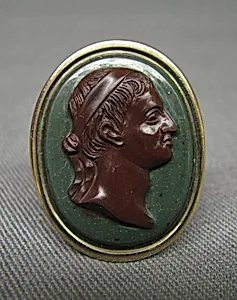
Medium
Jasper, gold mount
Dimensions
cameo: 15/16 × 3/4 × 1 in. (2.4 × 1.9 × 2.5 cm); ring: 1 1/8 × 7/8 × 1 in. (2.9 × 2.2 × 2.5 cm)
Classification
Lapidary Work-Gems
Culture
European
Department
European Sculpture and Decorative Arts
Museum
Metropolitan Museum of Art, New York, NY
Credit
Gift of Robert W. Hatem, 2008
Accession Number
2008.324.4
Rights
Public Domain
Tags
Art Historical Context
This exquisite cameo, titled *Head of a Hero Wearing Fillet*, captures the profile of an ancient-inspired hero adorned with a classical headband or fillet, symbolizing victory or divinity. Carved in 1777 from j—a durable, richly colored chalcedony prized for its layered bands that allow for striking relief effects—the tiny gem (just under an inch across) showcases the precision of lapidary artistry. Set within an ornate gold mount forming a ring, it transforms wearable jewelry into a miniature masterpiece, blending sculpture with personal adornment. Created during the height of European Neo-classicism, when artists revived Greco-Roman ideals amid Enlightenment fascination with antiquity, this piece reflects the era's passion for cameos as affordable echoes of ancient gems. Lapidary work like this demanded exceptional skill: engravers exploited jasper's natural contrasts to raise the hero's features against a shadowed ground, evoking marble busts in intimate scale. Though by an unknown hand, it exemplifies the decorative arts' role in democratizing classical heroism for 18th-century collectors. Today, housed in The Metropolitan Museum of Art's European Sculpture and Decorative Arts department (gift of Robert W. Hatem, 2008), this gem invites us to ponder how everyday objects carried profound cultural weight, bridging past glories with modern wearers.