
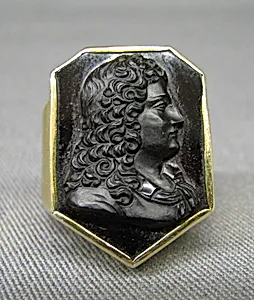
Bust of a man in a wig, possibly a writer
Unknown Artist
18th century
Medium
Sardonyx, mounted in gold as a ring
Dimensions
cameo: 1 × 11/16 in. (2.5 × 1.7 cm); ring: 1 1/8 × 3/4 × 1 in. (2.9 × 1.9 × 2.5 cm)
Classification
Lapidary Work-Gems
Culture
probably French
Department
European Sculpture and Decorative Arts
Museum
Metropolitan Museum of Art, New York, NY
Credit
Gift of Robert W. Hatem, 2008
Accession Number
2008.324.2
Rights
Public Domain
Tags
Art Historical Context
This delicate sardonyx cameo, carved as a bust of a man an elaborate wig—possibly a writer—dates to the 18th century andails from probably French workshops. Mounted in gold as a ring, it measures just 1 × 11/16 inches for the cameo itself, transforming a tiny gem into wearable portraiture. Such lapidary works, classified as gems in The Metropolitan Museum of Art's Sculpture and Decorative Arts collection, were prized jewels of the Enlightenment era, blending artistry with personal adornment. Crafted from layered sardonyx, the cameo employs the intaglio technique in reverse: artisans skillfully carved away the darker upper layer to reveal the lighter base beneath, creating a striking profile in high relief. This method, perfected in antiquity but revived in 18th-century Europe, captured the powdered wigs and refined features emblematic of French high society. Worn as a ring, it served not only as jewelry but also as a subtle emblem of intellect or status, evoking the literary salons of Voltaire's time. Today, gifted to the Met in 2008 by Robert W. Hatem, this intimate artwork invites us to ponder the anonymous sitter's story—perhaps a philosopher or poet frozen in stone for eternity. A testament to the lapidary's precision, it highlights how even the smallest objects carried profound cultural weight in Rococo France.