
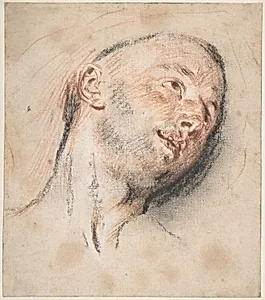
Head of a Man
ca. 1718
Medium
Red and black chalk
Dimensions
5 7/8 x 5 3/16 in. (14.9 x 13.1 cm)
Classification
Drawings
Department
Drawings and Prints
Museum
Metropolitan Museum of Art, New York, NY
Credit
Rogers Fund, 1937
Accession Number
37.165.107
Tags
Art Historical Context
Step into the intimate world of Antoine Watteau *Head of a Man* (ca. 1718), a masterful drawing that captures the French Rococo master's unparalleled sensitivity to human expression. Created with red and black chalk on a modest 5 7/8 x 5 3/16 inches sheet, this work exemplifies Watteau's (1684–1721) genius for portrait studies. As a pioneer of the Rococo style—known for its playful elegance and fêtes galantes—this piece likely served as a preparatory sketch, showcasing his fluid line work and subtle tonal modeling that brought his painted figures to life. Watteau's use of red chalk for warm f...
About the Artist
Antoine Watteau · 1684–1721
Jean-Antoine Watteau, born in 1684 in Valenciennes to a modest family—his father a roofer named Jean-Philippe Watteau—was the second of four sons who displayed an early passion for art. After initial apprenticeship under local painter Jacques-Albert Gérin, he moved to Paris around 1702, working in workshops copying Flemish and Dutch genre scenes. By 1705, he entered the studio of Claude Gillot, ab...