
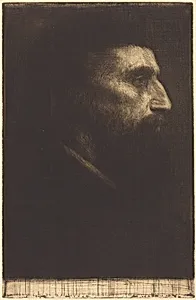
Head of a Man (Tete d'homme)
1826 to 1850
Medium
etching and aquatint?
Classification
Department
CG-E
Museum
National Gallery of Art, Washington, D.C.
Credit
Gift of George Matthew Adams in memory of his mother, Lydia Havens Adams
Accession Number
1952.10.58
Rights
Public Domain
Art Historical Context
### Head of a Man (ête d'homme) Nestled in the National Gallery of Art's Department of Prints (CG-E), *Head of a Man (Tête d'homme)* is striking 19th-century work by French artist Alphonse Legros, between 1826 and 1850. Legros, a pivotal figure in the etching revival, bridged French Realism and British art circles after settling in London. This intimate portrait captures the human form with direct intensity, reflecting the era's fascination with character studies amid the rise of modern printmaking. Crafted in etching and aquatint—a technique where resin dust creates velvety tones for shading, combined with etched lines for precise detail—the print showcases Legros's technical prowess. These methods allowed artists to achieve painterly depth on paper, making fine art accessible beyond paintings. The result is a textured, atmospheric study that invites close inspection, highlighting subtle facial contours and emotional nuance. Generously gifted by George Matthew Adams in memory of his mother, Lydia Havens Adams, this piece exemplifies the enduring appeal of 19th-century prints. It reminds us how Legros's innovations democratized portraiture, influencing generations of etchers and offering visitors a window into Victorian-era artistry. (198 words)
About the Artist
Alphonse Legros · 1837–1911
Alphonse Legros (1837–1911) was born in Dijon, France, and trained in Paris at the drawing school of Horace Lecoq de Boisbaudran, whose unconventional teaching method — which emphasised memory drawing and acute observation over academic convention — would leave a lasting mark on Legros's practice. At Lecoq's school he formed friendships with Jules Dalou and Auguste Rodin that endured throughout hi...