
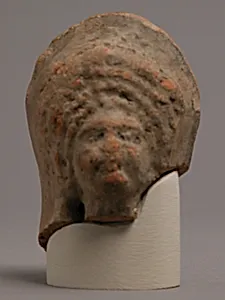
Head of a Woman
Unknown Artist
4th–7th century
Medium
Earthenware
Dimensions
Overall: 3 1/8 x 2 3/16 x 1 15/16 in. (8 x 5.5 x 5 cm)
Classification
Ceramics
Culture
Coptic
Department
Medieval Art
Museum
Metropolitan Museum of Art, New York, NY
Credit
Rogers Fund, 1925
Accession Number
25.10.23.43
Rights
Public Domain
Tags
Art Historical Context
This delicate earthenware *Head of a Woman*, crafted by an unknown Coptic artist between the 4th and 7th centuries, offers a glimpse into early Christian Egypt. Measuring just over three inches tall, this small ceramic sculpture captures a stylized female face with simplified features—likely exaggerated eyes and a serene expression—typical of Coptic art. Produced during a transformative era when Christianity flourished in Egypt amid fading Roman influence, such objects were often part of larger figurines used in domestic, funerary, or devotional contexts. Coptic ceramics like this one highlight the culture's fusion of ancient Egyptian traditions with emerging Byzantine styles. Earthenware, fired at relatively low temperatures, was an accessible medium for everyday artisans, allowing for intricate modeling despite its fragility. Acquired through the Rogers Fund in 1925, this piece now resides in the Metropolitan Museum of Art's Medieval Art department, underscoring the Copts' role in bridging Late Antiquity and the medieval world. Visitors will appreciate how this modest head evokes the daily lives of Coptic women, perhaps symbolizing fertility, protection, or piety in a vibrant, faith-filled society. Its intimate scale invites close contemplation, revealing the enduring humanity in ancient craftsmanship.