
Terracotta head
Unknown Artist
late 4th century BCE
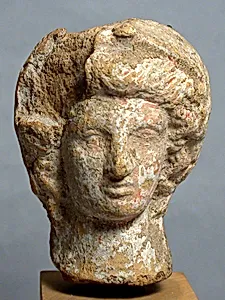
Medium
Terracotta, paint traces and white slip
Dimensions
H. 6.5 cm x W. 4.8 cm
Classification
Terracottas
Culture
Greek, Boeotian
Department
Greek and Roman Art
Museum
Metropolitan Museum of Art, New York, NY
Credit
Bequest of Nanette B. Kelekian, 2020
Accession Number
2021.40.23
Rights
Public Domain
Art Historical Context
This delicate terracotta head, crafted by an unknown Boeotian artist in the late 4th century, offers a glimpse into the vibrant world of ancient Greek daily life and devotion. Hailing from Boeotia—a region central Greece renowned for its prolific terracotta workshops—this small artifact (just 6.5 cm high and 4.8 cm wide) likely formed part of a votiveine offered at a sanctuary. During the late Classical period, as Greece transitioned toward the Hellenistic era, such objects bridged the divine and the everyday, depicting mortals or deities with naturalistic charm. The head's medium reveals masterful techniques: molded terracotta fired for durability, coated in white slip as a base for painting, with faint traces of original color still surviving. This polychromy brought these figures to life, their eyes, lips, and garments once vividly rendered in reds, blues, and golds—a testament to Boeotian artisans' skill in mass-producing accessible art for worshippers of all classes. Unlike grand marble sculptures, these intimate pieces democratized beauty and piety. Today, housed in the Metropolitan Museum of Art's Greek and Roman Art Department through the bequest of Nanette B. Kelekian in 2020, this head invites us to ponder the faces of ancient Greeks—perhaps a young woman or child—frozen in quiet eternity.