
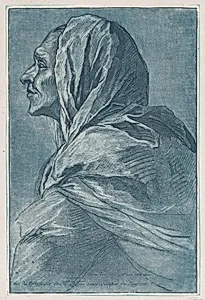
Head of a woman
Medium
Etching printed in blue ink
Dimensions
Sheet: 12 1/16 × 8 1/16 in. (30.6 × 20.4 cm)
Classification
Prints-Facsimiles
Department
Drawings and Prints
Museum
Metropolitan Museum of Art, New York, NY
Credit
The Elisha Whittelsey Collection, The Elisha Whittelsey Fund, 1951
Accession Number
51.501.4279
Rights
Public Domain
Art Historical Context
This delicate etching, titled *Head of a Woman*, dates to around 1758 and represents a fascinating example of 18th-century printmaking as a means of artistic preservation and dissemination. Created by Lambert Sigisbert Adam after a design associated with the earlier Baroque artist Pietro Testa, the work is classified as a print-facsimile—an intentional reproduction meant to capture and share the qualities of an original drawing or sketch for a wider audience. Its medium, an etching printed in blue ink rather than the common black, lends the image a soft, atmospheric quality that enhances the gentle contours of the woman’s features. Measuring just over 12 by 8 inches, the sheet exemplifies how reproductive prints played a vital role in the circulation of artistic ideas across Europe during the Enlightenment. Adam, a French sculptor and printmaker active in the mid-1700s, likely used this technique to honor Testa’s expressive style while making the composition accessible to collectors and scholars. Today, the impression resides in the Metropolitan Museum of Art’s Drawings and Prints collection, acquired through the Elisha Whittelsey Fund in 1951, where it continues to invite viewers to appreciate both the original artist’s vision and the craftsmanship of its later interpretation.