
Saint Jacob Minor
1595–1616
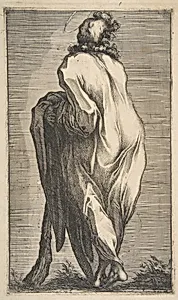
Medium
Etching and engraving
Dimensions
Sheet: 14 1/4 × 9 7/16 in. (36.2 × 23.9 cm) Plate: 11 5/16 × 6 11/16 in. (28.7 × 17 cm)
Classification
Prints
Department
Drawings and Prints
Museum
Metropolitan Museum of Art, New York, NY
Credit
The Elisha Whittelsey Collection, The Elisha Whittelsey Fund, and Harris Brisbane Dick Fund, by exchange, 1959
Accession Number
59.504
Rights
Public Domain
Tags
Art Historical Context
Jacques Bellange's *Saint Jacob Minor*, between 1595 and 1616, captures the quiet devotion of Saint James the Less, one of Christ's apostles, in a striking etching and engraving. Hailing from the Duchy of Lorraine in northeastern France, Bellange was a masterful printmaker whose works bridged Mannerism and early Baroque styles. This piece, now in the Metropolitan Museum of Art Drawings and Prints department, exemplifies his intricate technique, blending the fluid spontaneity of etching with the precise lines of engraving to achieve dramatic contrasts and luminous effects. During the Counter-Reformation era, religious prints like this one served as affordable devotional aids, allowing pilgrims and the faithful to carry sacred images in their pockets. Bellange's innovative use of the burin and etching needle produced richly textured surfaces, evoking the spiritual intensity of saints amid turbulent times of religious strife in Europe. Measuring a modest plate size of 11 5/16 × 6 11/16 inches, its intimate scale invites close contemplation. Acquired through prestigious funds including The Elisha Whittelsey Collection, this print highlights the Met's commitment to preserving rare Northern European graphics. Visitors will appreciate how Bellange's elegant, elongated figures reflect the era's artistic dialogue between Italian influences and regional traditions, making sanctity accessible and profound.
About the Artist
Jacques Bellange · 1570–1616
Jacques Bellange (c. 1575–1616) was a French artist and printmaker active in the independent Duchy of Lorraine, now part of France. Believed to have been born in the Bassigny region south of Nancy, his early life and training remain sparsely documented, with no records of specific teachers or mentors. He first appears in historical records in 1595 at La Mothe, where he took on an apprentice, sugge...