
Head of a Young Boy
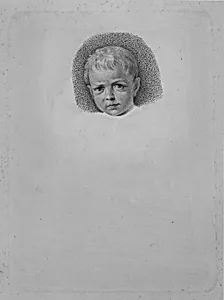
Medium
Stipple engraving
Dimensions
plate: 9 1/8 x 6 5/8 in. (23.1 x 16.8 cm) sheet: 10 1/8 x 7 1/2 in. (25.7 x 19.1 cm)
Classification
Prints
Department
Drawings and Prints
Museum
Metropolitan Museum of Art, New York, NY
Credit
The Elisha Whittelsey Collection, The Elisha Whittelsey Fund, 1960
Accession Number
60.620.102
Rights
Public Domain
Tags
Art Historical Context
Pierre-Paul Prud'hon, a leading French artist of the late 18 and early 19th, masterfully captured tenderness in *Head of a Young Boy an undated stipple engraving from the Metropolitan of Art's Drawings and collection. Prud'hon often bridging Neoclassicism and emerging Romanticism, was renowned his soft, luminous portraits and allegorical works that emphasized emotional depth and graceful forms. This intimate study exemplifies his skill in portraying youthful innocence, likely derived from a preparatory drawing. Stipple engraving, the medium here, is a refined printmaking technique using fine dots rather than lines to build subtle tones and textures, creating a velvety, painterly effect ideal for reproducing delicate features like the boy's serene expression and tousled hair. Popular in the Enlightenment era for its precision and affordability, it allowed artists like Prud'hon to disseminate their visions widely. Measuring just 9 1/8 x 6 5/8 inches the plate, this print invites close contemplation of its meticulous shading and gentle modeling. Acquired through The Elisha Whittelsey Collection in 1960, the work highlights Prud'hon's enduring influence on portraiture, evoking the era's fascination with childhood purity amid revolutionary change. A charming gem for print enthusiasts, it reminds us of art's power to preserve fleeting moments of humanity.
About the Artist
Pierre Paul Prud'hon · 1758–1823
Pierre Paul Prud'hon (1758–1823) was a French painter and draughtsman whose dreamy, sensuous art occupied a singular position between the Neoclassicism and Romanticism that competed for dominance in French painting around 1800. Born in Cluny in Burgundy, he received his early artistic training at the Dijon Academy before winning the Prix de Rome of the Estates of Burgundy, which allowed him to spe...