
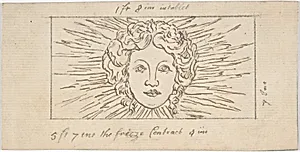
Head of Apollo in Glory
late 18th–early 19th century
Medium
Pen and brown ink over graphite
Dimensions
sheet: 2 15/16 x 5 3/4 in. (7.4 x 14.6 cm)
Classification
Drawings|Ornament & Architecture
Department
Drawings and Prints
Museum
Metropolitan Museum of Art, New York, NY
Credit
Rogers Fund, 1918, transferred from the Library
Accession Number
1974.548.2
Rights
Public Domain
Tags
Art Historical Context
This delicate drawing, titled *Head of Apollo in Glory*, captures the radiant visage of the Greek god Apollo, rendered by an anonymous British artist active during the late 18th and early 19th centuries. Executed in pen and brown ink over graphite on a small sheet measuring just under three by six inches, the work exemplifies the intimate scale often favored for preparatory studies or ornamental designs. The layered technique—beginning with graphite for structure and finishing with fluid ink lines—allows for both precision and expressive warmth, highlighting Apollo’s idealized features and the luminous “glory” that surrounds his head. Created during Britain’s Neoclassical period, when artists and architects drew heavily on classical antiquity for inspiration, this piece reflects the era’s fascination with Greek and Roman mythology. Apollo, deity of light, music, and prophecy, frequently appeared in architectural ornament, decorative schemes, and public monuments as a symbol of harmony and enlightenment. Though the artist remains unknown, the drawing’s classification among ornament and architecture suggests it may have served as a design element for a larger decorative project, such as a frieze, medallion, or interior motif. Housed in the Metropolitan Museum of Art’s Department of Drawings and Prints, the work offers modern viewers a glimpse into the meticulous process behind Neoclassical design. Its modest size invites close looking, rewarding visitors with an appreciation for how even small sketches contributed to the grand revival of classical ideals in British art and architecture.