
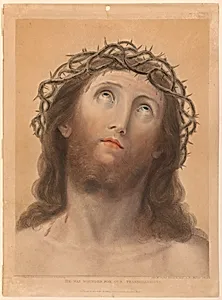
Head of Christ
Classification
Department
Smithsonian Collection
Museum
Smithsonian American Art Museum
Credit
Bequest of George Campbell Cooper
Accession Number
1896-3-310
Rights
Public Domain
About this artwork
Research in Progress
Art Historical Context
Francesco Bartolozzi’s *Head of Christ*, created in 1802, offers a quiet yet powerful devotional image from the hand of one of the most celebrated printmakers of his era. An Italian artist who spent much of his career in England, Bartolozzi helped popularize stipple engraving, a delicate technique that allowed subtle gradations of tone and a soft, almost painterly quality in black-and-white prints. This work, now part of the Smithsonian American Art Museum’s collection through the bequest of George Campbell Cooper, reflects the late phase of his long and influential career. Prints like this one played a vital role in the eighteenth and early nineteenth centuries by making religious imagery widely accessible. While the exact source or medium details remain under study, the subject of Christ’s head was a favorite for private contemplation, often reproduced after paintings by earlier masters. Bartolozzi’s refined approach brought a sense of intimacy and emotional depth to the theme, allowing viewers to engage with sacred art in their own homes. Today, the print stands as a testament to the enduring appeal of devotional imagery and the technical artistry that brought it to a broader public. Its presence in an American museum collection also highlights how European prints traveled across the Atlantic, shaping tastes and spiritual life well beyond their original context.