
Head of Dr. Bauer
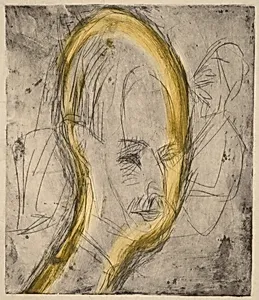
Medium
etching and drypoint printed in black with yellow monotype wiping
Dimensions
image: 19.3 x 16.3 cm (7 5/8 x 6 7/16 in.) sheet: 30.8 x 24.2 cm (12 1/8 x 9 1/2 in.)
Classification
Department
CG-W
Museum
National Gallery of Art, Washington, D.C.
Credit
Gift of Ruth Cole Kainen
Accession Number
2012.92.452
Rights
Public Domain
Art Historical Context
Ernst Ludwig Kirchner, a pioneering German Expressionist and co-founder of the Die Brücke group, created *Head of Dr. Bauer* in 1921 during his convalescence in the Swiss Alps. This intimate portrait captures Dr. Bauer, likely Kirchner's physician, amid the artist's post-World War I struggles with mental and physical health. Expressionism's raw emotional intensity shines through Kirchner's bold, angular lines, distorting features to convey inner turmoil and human vulnerability—a hallmark of the movement's rejection of academic realism. The work's medium—etching and drypoint printed in black with yellow monotype wiping—demonstrates Kirchner's innovative printmaking. Etching provides precise lines etched by acid, while drypoint's direct needle scratches create a soft, velvety burr for texture. The rare yellow wiping, a monotype technique, adds a luminous, hand-applied glow, transforming a typically monochromatic print into a vibrant, unique piece (image: 19.3 x 16.3 cm). Housed in the National Gallery of Art as a gift from Ruth Cole Kainen (Department CG-W), this print exemplifies Kirchner's mastery in capturing psychological depth. Visitors will appreciate its fusion of technique and emotion, offering a window into an artist's resilient spirit.
About the Artist
Ernst Ludwig Kirchner · 1880–1938
Ernst Ludwig Kirchner was born on May 6, 1880, in Aschaffenburg, Germany, to parents Ernst and Maria Kirchner, part of a family of Prussian descent that frequently relocated due to his father's career as a chemical technician. After early schooling in various towns, he studied architecture at the Königliche Technische Hochschule (Technical University) in Dresden from 1901 to 1905, taking courses i...