
Head of Man Smoking (from Sketchbook)
1854–55
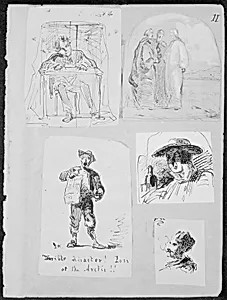
Medium
Brown ink on blue wove paper
Dimensions
2 5/16 x 1 3/4 in. (5.9 x 4.4 cm)
Classification
Drawing
Culture
American
Department
The American Wing
Museum
Metropolitan Museum of Art, New York, NY
Credit
Gift of Margaret C. Buell, Helen L. King, and Sybil A. Walk, 1970
Accession Number
1970.121.44
Rights
Public Domain
Tags
Art Historical Context
James McNeill Whistler’s *Head of Man Smoking ( Sketchbook)*, created around 1854–55, offers a glimpse into the young artist’s early draftsmanship. At just 21 years old, Whistlerborn in Massachusetts and later a key figure in the Aesthetic movement—was transitioning from his brief stint at West Point to artistic pursuits in Europe. This tiny drawing (2 5/16 x 1 3/4 inches) captures a casual, everyday moment: a man’s head in profile, puffing on a pipe or cigarette, rendered in fluid brown ink on striking blue wove paper. Housed in The Metropolitan Museum of Art’s American Wing, it celebrates Whistler’s American roots before his international fame. The medium is particularly evocative. Blue wove paper, popular in the mid-19th century for sketches, provides a cool backdrop that makes the warm brown ink lines pop, enhancing the portrait’s intimacy and immediacy. As a sketchbook study, it reveals Whistler’s keen observation of ordinary life, foreshadowing his lifelong interest in capturing fleeting impressions—seen later in his ethereal Nocturnes and bold portraits. For visitors, this unpretentious gem humanizes a master artist, reminding us that genius often begins in quiet, personal sketches. Its cultural nod to 19th-century smoking habits adds a relatable touch, inviting you to ponder the smoker’s contemplative gaze amid Whistler’s emerging genius.
About the Artist
James McNeill Whistler · 1834–1903
James Abbott McNeill Whistler (1834-1903) was an American-born painter and printmaker who became a leading figure in the Aesthetic Movement and pioneer of Tonalism and Japonisme. He revolutionized art by championing "art for art's sake" and treating paintings as visual equivalents of musical compositions, titling works as "arrangements," "harmonies," and "nocturnes" to emphasize formal qualities o...