
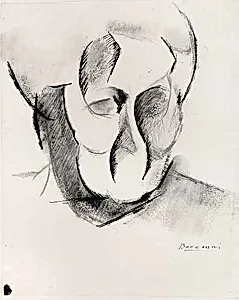
Head of the Artist's Mother
1915
Medium
Ink, wash and graphite on paper
Dimensions
12 1/4 × 9 1/2 in. (31.1 × 24.1 cm)
Classification
Drawings
Department
Modern and Contemporary Art
Museum
Metropolitan Museum of Art, New York, NY
Credit
Bequest of Lydia Winston Malbin, 1989
Accession Number
1990.38.30
Rights
Public Domain
Tags
Art Historical Context
Created in 1915, “Head of the Artist’s Mother” offers an intimate glimpse into the work of Umberto Boccioni, a leading voice of Italian Futurism. While Futurism often celebrated speed and modern machinery, this drawing reveals Boccioni’s quieter, more personal side. The tender portrayal of his mother captures a moment of reflection during a turbulent period that included the First World War, reminding viewers that even radical modernists drew inspiration from family and memory. Executed in ink, wash, and graphite on paper, the work highlights Boccioni’s mastery of fluid line and subtle tonal modeling. The combination of precise graphite contours with expressive washes of ink allows the forms to emerge softly from the page, demonstrating how traditional drawing techniques could convey both emotional depth and dynamic energy. At roughly twelve by nine inches, the modest scale invites close looking, encouraging visitors to appreciate the artist’s sensitive handling of light and shadow. Now part of the Metropolitan Museum’s modern drawings collection, this piece underscores the breadth of Futurist practice beyond its more famous paintings and sculptures. It stands as a testament to Boccioni’s ability to merge avant-garde ideas with timeless human subjects.
About the Artist
Umberto Boccioni · 1882–1916
Umberto Boccioni (1882–1916) was an Italian painter and sculptor who became the leading artist and principal theorist of the Futurist movement. Born in Reggio Calabria, he studied in Rome under the Divisionist painter Giacomo Balla and was deeply influenced by Post-Impressionism before encountering the ideas of Filippo Tommaso Marinetti, whose 1909 Futurist Manifesto catalyzed Boccioni's artistic ...