
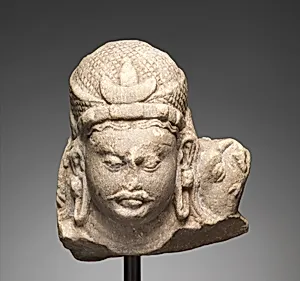
Head of Vaitunkta Vishnu
Unknown Artist
ca. 6th century
Medium
Stone, probably chlorite
Dimensions
H. 6 5/16 in. (16 cm); W. 5 3/8 in. (13.7 cm); D. 4 1/2 in. (11.4 cm)
Classification
Sculpture
Culture
Northern Pakistan (Brahmanical post-Gupta)
Department
Asian Art
Museum
Metropolitan Museum of Art, New York, NY
Credit
Purchase, Anonymous Gift, 2014
Accession Number
2014.688
Rights
Public Domain
Tags
Art Historical Context
Behold the serene *Head of Vaikun Vishnu*, a masterful 6th-century stone sculpture Northern Pakistan, crafted by an unknown artist in the Brahmanical post-Gupta tradition Carved from soft chlorite—a material prized for its workability—this compact piece (just over 6 inches tall) captures the divine visage of Vishnu, the Hindu preserver god, in a form known as Vaikuntha, often depicted with multiple heads symbolizing his cosmic aspects. Emerging from the Gandhara region, famed for blending Greco-Roman realism with Indian spirituality, this artwork reflects a pivotal shift from dominant Buddhist iconography to vibrant Hindu expression in the post-Gupta era. Northern Pakistan's workshops produced such refined sculptures amid cultural exchanges along ancient trade routes, showcasing Vishnu's prominence in Brahmanical devotion and the era's theological depth. Chlorite's subtle gray-green hue and fine grain enabled intricate detailing, evident in the smooth modeling that conveys divine tranquility. Acquired by the Metropolitan Museum of Art in 2014 through an anonymous gift, this rare survivor invites us to ponder the enduring allure of Hindu artistry in a crossroads of civilizations.