
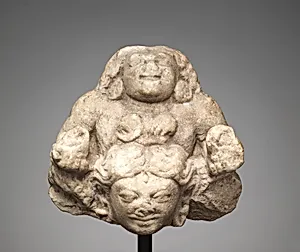
Head of Addorsed Maheshvara
Unknown Artist
ca. 6th century
Medium
Stone, probably chlorite
Dimensions
H. 5 1/8 in. (13 cm); W. 5 1/4 in. (13.3 cm); D. 3 1/4 in. (8.3 cm)
Classification
Sculpture
Culture
Northern Pakistan (Brahmanical post-Gupta)
Department
Asian Art
Museum
Metropolitan Museum of Art, New York, NY
Credit
Purchase, Anonymous Gift, 2014
Accession Number
2014.687
Rights
Public Domain
Tags
Art Historical Context
Behold the *Head of Addorsedheshvara*, a captivating6th-century stone sculpture northern Pakistan, crafted in the Brahmanical post-Gupta style This small yet intricate piece (just over 5 inches high) depicts the serene visage of Maheshvara—another name for the Hindu god Shiva, the " Lord"—rendered as addorsed figures, facing outward back-to-back. Likely carved from chlorite, soft gray stone prized in ancient Indian sculpture for its fine carvability, it exemplifies the technical finesse of regional artisans in the Gandhara region, where Greco-Roman influences once mingled with local traditions. Emerging in the post-Gupta era, this artwork reflects the resurgence of Brahmanical Hinduism amid shifting cultural landscapes in northern Pakistan. Gandhara, famed for its Buddhist art, also hosted vibrant Hindu expressions, as seen in Shiva's calm, meditative features symbolizing divine duality and cosmic balance. Such portable devotional objects were cherished for personal worship or temple altars, bridging the opulent Gupta classical age with medieval South Asian styles. Today, at the Metropolitan Museum of Art, this anonymous masterpiece invites us to ponder Shiva's enduring mystique—destroyer and renewer—frozen in chlorite eternity, a testament to ancient spiritual artistry.