
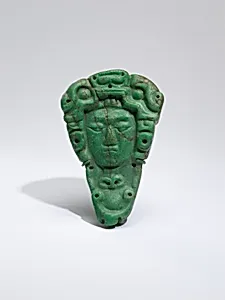
Head Pendant
Unknown Artist
6th–9th century
Medium
Jade (jadeite)
Dimensions
H. 3 3/8 in. (8.6 cm); W. 2 3/16 in. (5.5 cm); D. 11/16 in. (1.8 cm)
Classification
Jade
Culture
Maya (Mexico or Guatemala)
Department
Asian Art
Museum
Metropolitan Museum of Art, New York, NY
Credit
Gift of Heber R. Bishop, 1902
Accession Number
02.18.309
Rights
Public Domain
Tags
Art Historical Context
This exquisite *Head Pendant*, carved from jadeite by an unknown Maya artist between the 6th and 9th centuries, captures the refined artistry of the Late Classic Maya civilization in Mexico or Guatemala. Measuring just 3⅜ inches high, this petite sculpture depicts a stylized human face, likely worn as personal adornment by Maya elites. During this era, the Maya flourished with advanced cities, hieroglyphic writing, and complex rituals, where such jewelry symbolized status and spiritual power. Jadeite, a vivid green stone revered across Mesoamerica, held profound cultural significance for the Maya, representing fertility, water, and maize—the lifeblood of their agriculture. Artisans skillfully transformed this hard material using stone tools and abrasives, achieving smooth surfaces and intricate facial details like prominent eyes and a serene expression. The pendant's shallow relief and perforations suggest it hung from a cord, perhaps during ceremonies invoking ancestors or deities. Today, this rare treasure resides in the Metropolitan Museum of Art's Asian Art Department—a nod to jade's global allure—thanks to a 1902 gift from collector Heber R. Bishop. It offers visitors a tangible glimpse into Maya ingenuity, where beauty and belief intertwined in everyday elegance.