
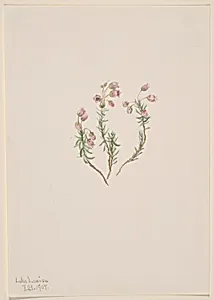
Heather (Phyllodoce intermedia)
Medium
Painting
Classification
Painting
Department
Smithsonian Collection
Museum
Smithsonian American Art Museum
Credit
Smithsonian American Art Museum, Gift of the artist
Accession Number
1970.355.225
Rights
Public Domain
Tags
Art Historical Context
Mary Vaux Walcott'sHeather (Phyllodo intermedia)*, painted in 1907, is a captivating depiction of the delicate wildflower Phyllodoce intermedia a hardy alpine plant native to North America's rocky terrains. Donated by the artist herself to the Smithsonian American Art Museum, painting exemplifies Walcott's passion for capturing nature's intricacies with precision and grace. Displayed in the Smithsonian Collection, it invites visitors to appreciate the subtle beauty of flora often overlooked in grander landscapes. Walcott, a trailblazing Canadian-American artist, naturalist, and mountaineer (1860–1940), created this work amid her adventures in the Rocky Mountains, where she documented wildflowers alongside geological expeditions with her husband, paleontologist Charles Doolittle Walcott. Active in the early 20th century, her paintings bridged art and science, contributing to botanical illustration at a time when women were rare in such fieldwork. Though classified simply as a painting, her style reflects meticulous realism, emphasizing scientific accuracy in form, color, and habitat. This piece holds cultural importance as part of Walcott's larger oeuvre, later published in her seminal book *North American Wild Flowers* (1925). It reminds us of the era's growing appreciation for environmental preservation and the artistry of observation, offering a timeless window into nature's quiet wonders.