
Helen Freeman
1921
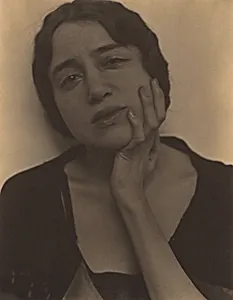
Medium
palladium print
Dimensions
image: 23.6 × 18.2 cm (9 5/16 × 7 3/16 in.) sheet: 25.2 × 20.1 cm (9 15/16 × 7 15/16 in.) mount: 56.5 × 46.4 cm (22 1/4 × 18 1/4 in.)
Classification
Photograph
Department
CPH
Museum
National Gallery of Art, Washington, D.C.
Credit
Alfred Stieglitz Collection
Accession Number
1949.3.505
Rights
Public Domain
Art Historical Context
In 1921, pioneering photographer Alfred Stieglitz captured *Helen Freeman* in a palladium print, a refined contact-printing process prized for its rich tonal gradations and archival permanence. Measuring about 9½ by 7¼ inches on its mount, this intimate portrait exemplifies Stieglitz's mastery of subtle light and form, inviting viewers into a moment of quiet revelation. Stieglitz, a founder of the Photo-Secession movement, championed photography as a fine art in the early 20th century through his New York gallery, "291." By the 1920s, he had shifted toward "straight photography," emphasizing unmanipulated reality over pictorialist softness. The palladium medium, akin to platinum printing but warmer in tone, allowed him to achieve velvety blacks and luminous highlights, underscoring his quest for emotional equivalence in imagery. Housed in the National Gallery of Art's Alfred Stieglitz Collection, this work reflects his fascination with the human spirit amid modernism's rise. A testament to photography's evolution, it draws us closer to the era's cultural pulse.
About the Artist
Alfred Stieglitz · 1864–1946
Alfred Stieglitz (1864-1946) was a pioneering American photographer, art dealer, publisher, and advocate for the Modernist movement who was instrumental over his 50-year career in making photography an accepted art form. Born in Hoboken, New Jersey, to German Jewish immigrant parents, Stieglitz spent his formative years studying mechanical engineering in Berlin, where he discovered photography in ...