
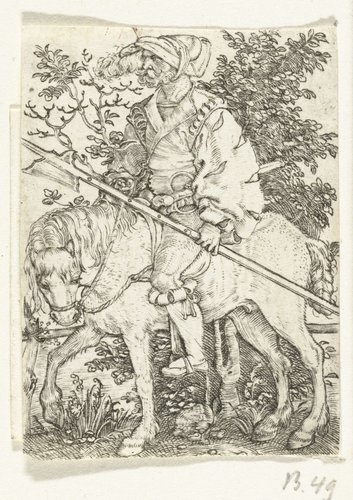
Hellebaardier te paard
1512 - 1540
Medium
engraving
Dimensions
59; 43
Rights
Public Domain
About this artwork
collector's mark: Lugt 240
Art Historical Context
Behold the intricate engraving *Hellebaardier te paard* (Halberdier on Horseback) by Barthel Beham a master of the German Renaissance. Created between 1512 and 1540, this diminutive work measures just 59mm high by 43mm wide, exemplifying the "Little Masters" of Nuremberg—artists like Beham who achieved astonishing detail in miniature formats. Beham, active from around 1502 until his death in 154, was renowned for his precise line work and genre subjects, often depicting soldiers, peasants, and everyday life with a keen eye for realism. Engraving, Beham's chosen medium, involved incising fine lines into a copper plate with a burin, inking it, and pressing paper to capture the image. This technique revolutionized art dissemination in the 16th century, allowing affordable multiples that reached collectors across Europe. Here, the mounted halberdier—armed with his signature pole weapon—evokes the era's military culture, amid the Italian Wars and Holy Roman Empire skirmishes, blending chivalric prowess with Renaissance naturalism. Adorned with a collector's mark (Lugt 240), this piece whispers of its esteemed provenance, a testament to enduring appreciation for Beham's virtuosity. Up close, marvel at the fluid shading and dynamic pose, a tiny window into 16th-century valor.
About the Artist
Barthel Beham · 1502–1540
Barthel Beham (1502–1540), a pivotal figure in the German Renaissance, was born in Nuremberg into a family of artists. The younger brother of the renowned engraver Hans Sebald Beham, he honed his craft under the tutelage of his elder sibling and the master Albrecht Dürer, absorbing the precise techniques of engraving and painting that defined Nuremberg's vibrant artistic scene. Emerging as a prodi...