
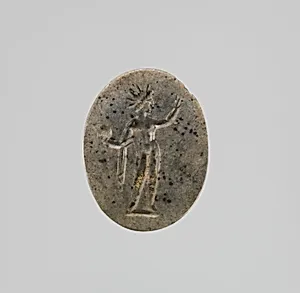
Hematite intaglio: Standing deity
Unknown Artist
Medium
Hematite
Dimensions
Other: 1/2 x 3/8 x 1/8 in. (1.3 x 1 x 0.2 cm)
Classification
Gems
Culture & Period
Roman · Imperial
Department
Greek and Roman Art
Museum
Metropolitan Museum of Art, New York, NY
Credit
Purchase by subscription, 1895
Accession Number
95.15.56
Rights
Public Domain
Art Historical Context
This exquisite hematite intaglio, depicting a standing deity, is a tiny marvel from the Roman Imperial periodca. 27 BCE–476 CE). Carved in intaglio technique—where the image is incised into the stone's surface rather than raised like a cameo—this gem measures just 1/2 x 3/8 x 1/8 inches, small enough to wear as a ring or pendant. Hematite, an iron ore for its metallic sheen and durability, was a popular choice for such personal artifacts, allowing fine details to emerge when the seal was pressed into wax. In Roman culture, intaglios like this served practical and symbolic purposes: as seals for documents, signet rings for the elite, or amulets invoking divine protection. The standing deity—likely a god or goddess such as Jupiter, Venus, or a mystery cult figure—reflects the polytheistic worldview of Imperial Rome, where portable piety bridged everyday life and the divine. Acquired by subscription in 1895, this piece now graces the Metropolitan Museum of Art's Greek and Roman Art department, exemplifying the artistry of anonymous gem-cutters who mastered micro-scale engraving. Though the exact date and creator remain unknown, the intaglio's survival highlights the enduring appeal of Roman gems, blending craftsmanship, spirituality, and status in a single polished stone.