
Henri II de Lorraine, duc de Guise
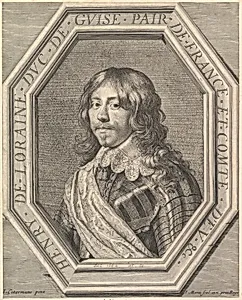
Medium
Etching, second state
Dimensions
sheet: 11 15/16 x 10 1/8 in. (30.3 x 25.7 cm) image: 11 7/16 x 9 3/16 in. (29 x 23.3 cm)
Classification
Prints
Department
Drawings and Prints
Museum
Metropolitan Museum of Art, New York, NY
Credit
The Elisha Whittelsey Collection, The Elisha Whittelsey Fund, 1962
Accession Number
62.650.207
Rights
Public Domain
Tags
Art Historical Context
This striking etching portrays Henri II de Lorraine, the 3rd Duc de Guise (1592–1664), a prominent French nobleman and military leader during the turbulent era of the French Wars of and the early reign of Louis XIII. As a key figure in the Catholic League and later in plots against Cardinal Richelieu, Gu embodied the aristocratic power struggles of 17th-century Europe. portrait, in its second state, captures his presence, likely after an original painting by Justus Sust, the esteemed Flemish Baroque artist and court painter to the Medici in Florence. Jean Morin, a skilled French engraver active in the early 1600s, translated Sustermans's work into etching—a revolutionary printmaking technique that allowed for intricate lines and tonal depth through acid-bitten plates. The second state refers to a refined edition with added details or corrections, enhancing its fidelity to the source. Measuring about 12 by 10 inches, this print from The Metropolitan Museum of Art's Elisha Whittelsey Collection exemplifies how etchings democratized elite portraiture, making noble likenesses accessible beyond oil paintings. Through its precise lines and dramatic shading, the work reflects Baroque portraiture's emphasis on status and realism, inviting visitors to ponder Guise's legacy amid France's path to absolutism. A testament to collaborative artistry across borders, it bridges painting and print cultures of the age.
About the Artist
Jean Morin|Justus Sustermans · 1605–1650
Jean Morin (c. 1605–1650) was one of the most accomplished French engravers of the seventeenth century, a master of the portrait print whose work stands among the finest examples of French graphic art in its era. Little is known about his early life or training, though his technique suggests exposure to both French and Flemish engraving traditions, the latter being the dominant force in European p...