
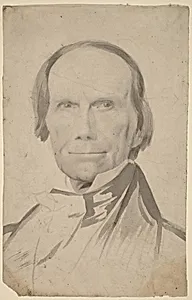
Henry Clay
c. 1840
Medium
graphite with gray wash on wove paper
Dimensions
overall: 20.9 x 13.3 cm (8 1/4 x 5 1/4 in.)
Classification
Drawing
Department
CG-W
Museum
National Gallery of Art, Washington, D.C.
Credit
John Davis Hatch Collection, Avalon Fund
Accession Number
1982.4.3
Rights
Public Domain
Art Historical Context
This delicate graphite drawing with gray wash on wove paper captures the likeness of Henry Clay, one of America's most influential statesmen of the 19th century. Created around 1840 by Charles Wesley Jarvis a skilled portraitist known for his precise renderings of prominent figures, work measures a modest 20.9 x 13.3 cm, suggesting it served as a preparatory study—likely for a larger painting or print. Jarvis, active in New York during the early antebellum period, employed meticulous line work and subtle tonal washes to convey Clay's dignified features, from his tousled hair to his intense gaze. Henry Clay, dubbed "The Great Compromiser," was a towering political figure in the era of Jacksonian democracy and rising sectional tensions. By 1840, he was a leading Whig presidential candidate, advocating for economic nationalism and compromise on slavery debates. This intimate portrait reflects the era's fascination with celebrity politicians, immortalizing Clay amid his bids for the White House. The use of graphite and gray wash exemplifies 19th-century draftsmanship techniques, allowing artists like Jarvis to achieve depth and realism on paper with economical means. Housed in the National Gallery of Art's John Davis Hatch Collection, this drawing offers a window into the preparatory artistry behind formal portraits, blending technical finesse with historical gravitas.
About the Artist
Charles Wesley Jarvis · 1812–1868
**Charles Wesley Jarvis (1812–1868)** was an American portrait painter and the second son of the renowned New York artist John Wesley Jarvis. Born in New York City, he followed directly in his father’s footsteps as a portraitist during the mid-nineteenth century. As the son of one of the leading portrait painters of the early republic, Jarvis trained in the family studio and absorbed the techniqu...