
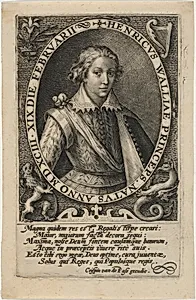
Henry Frederick, Prince of Wales
published 1604
Medium
engraving
Dimensions
plate: 14.2 × 9 cm (5 9/16 × 3 9/16 in.)
Classification
Department
CG-E
Museum
National Gallery of Art, Washington, D.C.
Credit
Rosenwald Collection
Accession Number
1950.14.659
Rights
Public Domain
Art Historical Context
This engraving by Crispijn de Passe I captures Henry Frederick, Prince of Wales, in 1604, shortly after his father, James I, ascended the English throne. As the eldest son and heir apparent, Henry was celebrated as a promising young leader, embodying hopes for a stable Protestant succession. De Passe, a skilled Dutch printmaker working across Europe, created this intimate portrait to reach a wide audience through the affordable medium of engraving. Measuring just 14.2 by 9 centimeters, the plate demonstrates the precision of early seventeenth-century printmaking. Fine lines and careful shading convey the prince’s youthful features and regal attire, allowing viewers to connect with royalty beyond the court. Such prints played a vital role in shaping public perception, circulating images of the new Stuart dynasty throughout Britain and the continent. Part of the National Gallery of Art’s Rosenwald Collection, this work highlights how engravings preserved and popularized royal likenesses during a pivotal moment in British history. Its modest scale and detailed execution invite close looking, revealing both the artistry and the political messaging embedded in early modern portraiture.
About the Artist
Crispijn de Passe I
Crispijn de Passe I, born around 1564 in Arnemuiden, Zeeland, emerged as one of the most influential Dutch engravers and print publishers of his era. He relocated to Antwerp as a youth, where he honed his craft amid the city's vibrant printmaking scene, becoming an independent master in the Guild of Saint Luke by 1584–1585. There, he worked as a reproductive engraver, primarily after designs by pr...