
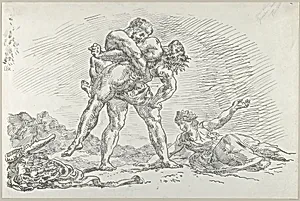
Hercules and Antaeus
1852
Medium
Lithograph on wove paper; only state
Dimensions
Overall: 17 3/8 x 11 1/2 in. (44.2 x 29.2 cm)
Classification
Prints
Department
Drawings and Prints
Museum
Metropolitan Museum of Art, New York, NY
Credit
Harris Brisbane Dick Fund, 1931
Accession Number
31.77.23
Rights
Public Domain
Tags
Art Historical Context
Eugène Delacroix, a towering figure of French Romanticism, captured the raw power of classical mythology in his 1852 lithograph *Hercules and Antaeus*. This dynamic print depicts the heroic moment when Hercules lifts the giant Antaeus—son of Earth goddess Gaia—off the ground, breaking his invincibility and ensuring victory. Delacroix's composition brims with muscular tension and dramatic struggle, embodying Romantic ideals of passion, heroism, and the sublime forces of nature. Printed on wove paper in a single state, this lithograph showcases Delacroix's mastery of the medium, which he championed for its fluid, painterly qualities. Unlike rigid engravings, lithography allowed his spontaneous, expressive drawing style—directly from crayon on stone—to translate the energy of his oil paintings into affordable multiples. At 17 3/8 x 11 1/2 inches, it's an intimate yet intense work, acquired through the Harris Brisbane Dick Fund for the Metropolitan Museum of Art's Drawings and Prints collection. This piece reflects mid-19th-century fascination with ancient myths amid Europe's revolutionary upheavals, symbolizing human triumph over primal chaos. Delacroix's innovative printmaking bridged fine art and popular dissemination, influencing generations. Gaze closely at the intertwined forms to feel the mythic pulse!
About the Artist
Eugène Delacroix · 1798–1863
Eugène Delacroix (1798–1863) stands as the defining figure of French Romanticism and a pivotal bridge to modernism. Born in Charenton-Saint-Maurice near Paris, he came from distinguished lineage—his mother descended from the prestigious Oeben-Riesener furniture dynasty, while persistent speculation suggested the statesman Talleyrand may have been his biological father, a theory supported by physic...