
Hercules and Antaeus
Medium
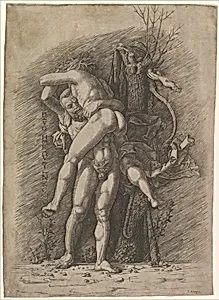
Engraving; main figures and parts of tree pricked for transfer
Dimensions
Height: 13 15/16 in. (35.4 cm) Width: 9 11/16 in. (24.6 cm)
Classification
Prints
Department
Drawings and Prints
Museum
Metropolitan Museum of Art, New York, NY
Credit
Rogers Fund, 1918
Accession Number
18.65.3
Rights
Public Domain
Tags
Art Historical Context
In the late 15th century, Andrea Mantegna, a pioneering Italian Renaissance artist renowned for his mastery of perspective and classical motifs, collaborated with Gian Marcoalli to create *Hercules and Antaeus* around 1497. This dynamic engraving captures the climactic moment from Greek mythology when the hero Hercules lifts the giant Antaeus off the earth—depriving him of his mother Gaia's life-giving strength—to crush him in victory. Mantegna's precise, sculptural figures evoke ancient Roman sarcophagi, blending mythological drama with Renaissance humanism. The work's medium is particularly intriguing: an engraving on a large sheet (13 15/16 x 9 11/16 inches), with the main figures and tree branches pricked for transfer. This technique, akin to pouncing, allowed artists to trace the design onto walls or panels for frescoes or paintings, highlighting prints' role as versatile tools in Renaissance workshops. Mantegna, one of the era's first major printmakers, elevated engraving from reproductive craft to original art, influencing northern European artists like Dürer. Housed in the Metropolitan Museum of Art's Drawings and Prints department (Rogers Fund, 1918), this piece exemplifies the cultural revival of Herculean labors, symbolizing triumph over chaos. Visitors will appreciate its technical finesse and the window it offers into the collaborative, innovative spirit of Renaissance Italy.
About the Artist
Andrea Mantegna|Gian Marco Cavalli · 1431–1506
Andrea Mantegna was born around 1431 near Padua, in the Venetian Republic, the son of a carpenter. At approximately age eleven he was taken into the workshop of the Paduan painter and antiquities collector Francesco Squarcione, who enrolled him as a guild member and immersed him in the study of Roman sculpture and classical Latin. Though Mantegna later claimed that Squarcione had exploited his lab...