
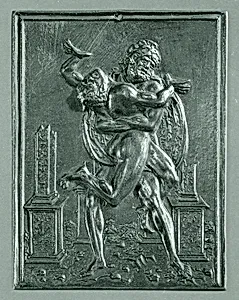
Hercules and Antaeus
model ca. 1488–89 (probably cast 16th century)
Medium
Copper alloy with a brown natural patina under a dark layer of wax; pierced at the top.
Dimensions
7.5 x 5.9 cm, wt. 63.26 g.
Classification
Plaquettes
Department
Robert Lehman Collection
Museum
Metropolitan Museum of Art, New York, NY
Credit
Robert Lehman Collection, 1975
Accession Number
1975.1.1346
Rights
Public Domain
Tags
Art Historical Context
In the Robert Lehman Collection at The Metropolitan Museum of Art lies a captivating small-scale bronze plaquette, *Herc and Antaeus*, modeled around 1488–89 by Galeazzo Mondella, known Moderno. This Italian artist, active in the late Renaissance hubs of Padua and Rome specialized in plaquettes—intimate, low-relief plaques that served as affordable Renaissance collectibles, blending classical mythology with virtuoso craftsmanship. Depicting the mythic wrestling match between Hercules and the giant Antaeus, the scene captures the hero hoisting his foe aloft, severing Antaeus's earth-born strength in a dynamic twist of muscle and tension. Crafted from copper alloy, this 7.5 x 5.9 cm gem (weighing just 63.26 g) boasts a rich brown natural patina sealed under dark wax, with a pierced top suggesting it hung as a pendant or devotional ornament. Likely cast in the 16th century from Moderno's original model, it exemplifies the era's revival of antiquity: plaquettes like this were prized by scholars and nobles for their portable erudition, bridging ancient Greek lore with early modern artistry. Moderno's precise chasing and high-relief modeling bring the struggle vividly to life, making this tiny powerhouse a window into Renaissance humanism's passion for heroic tales.
About the Artist
Moderno (Galeazzo Mondella) · 1467–1528
Moderno, identified by scholars as the goldsmith and medallist Galeazzo Mondella (c. 1467–c. 1528), was among the most gifted Italian artists working in small-scale bronze and lead relief at the turn of the sixteenth century. The pseudonym Moderno, meaning simply "the modern one," signals both the esteem in which his contemporaries held his work and his own conscious alignment with the revival of ...