
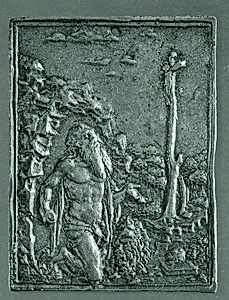
St. Jerome in the Wilderness
model ca. 1490 (possibly cast 16th century)
Medium
Copper alloy, with reddish brown natural patina; pierced at the top.
Dimensions
7.5 x 5.7 cm, wt. 76.32 g.
Classification
Plaquettes
Department
Robert Lehman Collection
Museum
Metropolitan Museum of Art, New York, NY
Credit
Robert Lehman Collection, 1975
Accession Number
1975.1.1344
Rights
Public Domain
Tags
Art Historical Context
Nestled in the Robert Lehman Collection at The Metropolitan Museum of Art, intimate plaquette titled *St. Jerome in Wilderness* showcases the mastery of Galeazzo Mondella, known Moderno, a pioneering Italian artist active in the late 15th and early 16th centuries. Modeled around 1490 and possibly cast later in the 16th century the 7.5 x 5.7 cm copper alloy relief bears a rich reddish-brown natural patina, evoking the passage of time. Pierced at the top, it likely designed for personal devotion—perhaps worn as a pendant or hung in a private chapel. St. Jerome, the scholarly hermit and Doctor of the Church, is a quintessential Renaissance subject, often depicted in penitential solitude contemplating the Crucifixion. Here, the low-relief composition captures his spiritual intensity amid wilderness motifs, blending classical influences with Christian iconography. Moderno, renowned for his plaquettes—small, collectible bronze or alloy panels—excelled in fine detailing and narrative depth, making complex theology accessible on a pocket-sized scale. Plaquettes like this bridged sculpture and printmaking, popular among Renaissance collectors for their portability and affordability compared to larger works. Weighing just 76.32 grams, this piece exemplifies the era's innovative metalwork techniques, inviting visitors to ponder Jerome's timeless call to reflection and redemption.
About the Artist
Moderno (Galeazzo Mondella) · 1467–1528
Moderno, identified by scholars as the goldsmith and medallist Galeazzo Mondella (c. 1467–c. 1528), was among the most gifted Italian artists working in small-scale bronze and lead relief at the turn of the sixteenth century. The pseudonym Moderno, meaning simply "the modern one," signals both the esteem in which his contemporaries held his work and his own conscious alignment with the revival of ...