
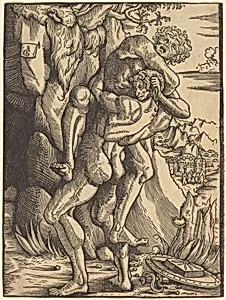
Hercules and Antaeus
c. 1528
Medium
woodcut on laid paper
Dimensions
sheet (trimmed to block): 19.6 × 14.7 cm (7 11/16 × 5 13/16 in.)
Classification
Department
CG-E
Museum
National Gallery of Art, Washington, D.C.
Credit
Rosenwald Collection
Accession Number
1951.10.115
Rights
Public Domain
Art Historical Context
Behold *Hercules and Ant*, a dynamic woodcut by the French printmaker Gabriel Salmon, created around 1528. This small powerful print (19.6 × 14.7 cm) captures the climactic moment from classical mythology the hero Hercules lifts the giant Antaeus off the earth—depriving him of his mother Gaia's life-giving strength—and crushes him in a hug. Salmon, active in early 16th-century France, drew on Renaissance fascination with ancient tales, blending them with the era's growing interest in humanism and heroic ideals. Printed on laid paper using the woodcut technique—a relief method where the artist carves away negative space from a wood block— this work exemplifies the medium's versatility for bold, expressive lines and high contrast. Woodcuts were revolutionary for their affordability, allowing widespread dissemination of art beyond elite patrons, much like early mass media. Trimmed to the block's edges, it hints at the print's original, unadorned presentation. Housed in the National Gallery of Art's Rosenwald Collection, this piece highlights Salmon's skillful rendering of musculature and motion, bridging Northern European woodcut traditions with French elegance. A testament to the print's cultural role, it invites us to marvel at how myths endured through innovative techniques, bringing epic struggles to everyday viewers.