
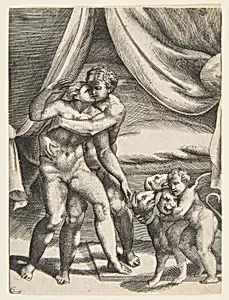
Pluto and Proserpine, from "The Loves of the Gods"
ca. 1531–76
Medium
Engraving
Dimensions
sheet: 5 5/16 x 4 5/16 in. (13.5 x 11 cm)
Classification
Prints
Department
Drawings and Prints
Museum
Metropolitan Museum of Art, New York, NY
Credit
Rogers Fund, 1962
Accession Number
62.602.145(9)
Rights
Public Domain
Tags
Art Historical Context
Behold *Pluto and Proserpine*, a captivating engraving by the Italian artist Giulio Bonasone, created around 1531–76 as part of his series *The Loves of the Gods*. This intimate sheet, measuring just 5 5/16 x 4 5/16 inches, dramatizes the classical myth from Ovid's *Metamorphoses*, where Pluto, god of the underworld, abducts the beautiful Proserpine, daughter of Ceres. Bonasone, a masterful Bolognese engraver influenced by Renaissance giants like Raphael and Michelangelo, captures the tension of the moment with swirling figures, including playful putti (cherubic children), alert dogs, and Proserpine's dynamic nude form—hallmarks of Mannerist style emphasizing elegance and emotion. Engravings like this were revolutionary in the 16th century, allowing detailed reproductions of grand paintings to reach collectors across Europe via affordable prints. Bonasone's precise incisions on a metal plate, inked and pressed onto paper, showcase his technical virtuosity, blending fine lines for texture and depth. Housed in the Metropolitan Museum of Art's Drawings and Prints department (Rogers Fund, 1962), it reflects the era's fascination with pagan myths as metaphors for human passion and power. This work invites us to ponder eternal themes of desire and transformation, its small scale belying a monumental narrative that once adorned scholars' studies and sparked artistic inspiration.
About the Artist
Giulio Bonasone · 1500–1600
Comment on works: History; Mythology