
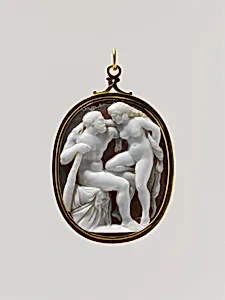
Hercules and Omphale
Unknown Artist
late 17th–early 18th century
Medium
Sardonyx, mounted in gold as a pendant
Dimensions
Overall: 3 x 1 7/8in. (7.6 x 4.8cm); visible cameo: 54 x 43 mm
Classification
Lapidary Work-Gems
Culture
probably Italian
Department
European Sculpture and Decorative Arts
Museum
Metropolitan Museum of Art, New York, NY
Credit
Gift of J. Pierpont Morgan, 1917
Accession Number
17.190.999
Rights
Public Domain
Tags
Art Historical Context
This exquisite cameo pendant, titled *Hercules and Omale*, showcases a captivating scene from classical mythology carved in sardonyx and mounted in gold. The mighty hero Hercules, punished for his crimes, serves Queen Omphale of Lydia in a role-reversal tale of humility and sensuality—often depicted with the pair exchanging attire, their nude forms emphasizing vulnerability and power dynamics. Measuring just 3 x 1⅞ overall, with the visible cameo at 54 x 43 mm, its intimate scale belies the sculptor's extraordinary skill. Crafted in the late 17th to early 18th century, probably in Italy, this lapidary work exemplifies the Baroque-era revival of ancient gem-carving techniques. Sardonyx, with its layered bands of reddish-brown and white chalcedony, allowed the artist to exploit natural contrasts for dramatic depth and modeling, rendering the figures' musculature and curves with lifelike precision. Such cameos were prized as wearable jewelry for Europe's elite, blending artistry with personal adornment. A gift from J. Pierpont Morgan to The Metropolitan Museum of Art in 1917, this piece from the European Sculpture and Decorative Arts department highlights the cultural prestige of mythological nudes and the technical mastery of Italian gem engravers during a golden age of decorative arts.