
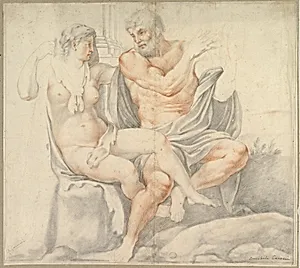
Hercules and Omphale
1560–1609
Medium
Red and black chalk; outlines partly pricked for transfer; framing outlines in black chalk
Dimensions
sheet: 15 3/8 x 17 in. (39 x 43.3 cm)
Classification
Drawings
Department
Drawings and Prints
Museum
Metropolitan Museum of Art, New York, NY
Credit
Gift of Cephas G. Thompson, 1887
Accession Number
87.12.82
Rights
Public Domain
Tags
Art Historical Context
Annibale Carracci’s *Hercules and Omphale* captures a lively moment from classical mythology in which the mighty hero is shown in a playful reversal of roles with the Lydian queen. Created between 1560 and 1609, the drawing reflects Carracci’s central role in the early Baroque reform of art, as he and his family moved away from artificial Mannerist conventions toward a more natural, classically inspired style grounded in observation and expressive gesture. Executed in red and black chalk with outlines partly pricked for transfer, the sheet reveals the practical working methods of a seventeenth-century draftsman. Pricking allowed the design to be transferred to another surface—perhaps a canvas or fresco—while the combination of chalks lends warmth and sculptural volume to the figures. The presence of female nudes and the powerful form of Hercules underscores Carracci’s interest in the human body as a vehicle for both narrative and ideal beauty. Measuring just over fifteen by seventeen inches, this intimate study now in the Metropolitan Museum of Art’s collection offers visitors a rare glimpse into the creative process behind larger finished works. Its generous gift to the museum in 1887 continues to illuminate the technical brilliance and humanistic spirit of one of Bologna’s most influential masters.
About the Artist
Annibale Carracci · 1560–1609
Annibale was considered one of the greatest Italian painters of his age. His style is marked by naturalism combined with the formal language of Classicism in a grand and monumental style. Annibale was also instrumental in evolving the ideal, classical landscape and is generally credited with the invention of caricature. Italian painter. Comment on works: Mythology.