
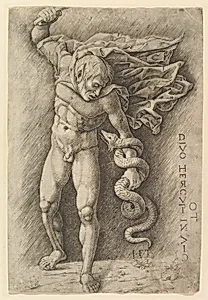
Hercules and the Hydra
n.d.
Medium
Engraving
Dimensions
Height: 11 5/16 in. (28.7 cm) Width: 7 11/16 in. (19.5 cm)
Classification
Prints
Department
Drawings and Prints
Museum
Metropolitan Museum of Art, New York, NY
Credit
Harris Brisbane Dick Fund, 1925
Accession Number
25.2.34
Rights
Public Domain
Tags
Art Historical Context
Behold *Hercules and the*, a masterful engraving by the Renaissance genius Mantegna (143–1506). This print captures the mythological hero in fierce combat with the-headed Lernaean Hydra, one of his legendary Twelve Labors. Measuring just 11 5/16 by 7 11/16 inches, the intimate scale belies its monumental energy, with Hercules' muscular nude form twisting powerfully amid writhing serpents. Mantegna, a pioneer of Italian printmaking from Padua, elevated engraving to high art in the late 15th century. His precise, incisive lines—reminiscent of his groundbreaking frescoes like those in the Camera degli Sposi—create dramatic chiaroscuro effects and illusionistic depth, showcasing his obsession with classical antiquity and anatomical precision. As one of the earliest major engravers north of the Alps' influence, Mantegna's works spread Renaissance ideals across Europe. Housed in The Metropolitan Museum of Art's Drawings and Prints department (Harris Brisbane Dick Fund, 1925), this piece celebrates heroic nudity and mythic valor, echoing Greco-Roman sculptures that inspired Renaissance artists. It's a window into how myths fueled humanist imagination, blending raw power with exquisite technique for enduring fascination.
About the Artist
Andrea Mantegna · 1431–1506
Andrea Mantegna was born around 1431 near Padua, in the Venetian Republic, the son of a carpenter. At approximately age eleven he was taken into the workshop of the Paduan painter and antiquities collector Francesco Squarcione, who enrolled him as a guild member and immersed him in the study of Roman sculpture and classical Latin. Though Mantegna later claimed that Squarcione had exploited his lab...