
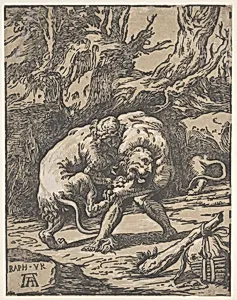
Hercules and the Nemean Lion
Medium
Chiaroscuro woodcut from two blocks in green (state ii)
Dimensions
Sheet: 9 13/16 × 7 5/8 in. (25 × 19.4 cm)
Classification
Prints
Department
Drawings and Prints
Museum
Metropolitan Museum of Art, New York, NY
Credit
Rogers Fund, 1922
Accession Number
22.73.3-64
Rights
Public Domain
Tags
Art Historical Context
Welcome to the Metropolitan Museum of Art's Drawings and Prints collection, where *Hercules and the Nemean Lion* (ca. 1540–50) captures one of the ancient hero's most iconic feats. This chiaroscuro woodcut depicts Hercules wrestling the fearsome Nemean Lion, whose impenetrable hide he famously strangled in his first labor from Greek mythology. Printed from two blocks in green tones (state II), the sheet measures 9 13/16 × 7 5/8 inches, showcasing the Renaissance revival of classical tales through accessible printmaking. Associated with master engravers Niccolò Vicentino and Andrea Andreani after a design by Raphael (Raffaello Sanzio da Urbino), the work exemplifies the High Renaissance fascination with heroic antiquity. Raphael's influence shines in the dynamic composition and idealized anatomy, while the chiaroscuro technique—using tone blocks for light and shadow—mimics the dramatic modeling of oil paintings, making woodcuts a sophisticated rival to engravings. This innovative method, perfected in mid-16th-century Italy, brought painterly depth to affordable prints. Acquired through the Rogers Fund in 1922, this piece highlights prints' role in disseminating Renaissance art across Europe, turning mythic drama into everyday inspiration for scholars and admirers alike. A testament to artistic collaboration and technical ingenuity!
About the Artist
Niccolò Vicentino|Raphael (Raffaello Sanzio or Santi)|Andrea Andreani · 1540–1550
**Niccolò Vicentino (also known as Giuseppe Niccolò Rospigliosi or Rossigliani, called Vicentino)** was an Italian Renaissance painter and wood-engraver active primarily in the mid-16th century. Born in Vicenza around 1525, he worked in Bologna circa 1550. He specialized in the demanding technique of chiaroscuro woodcuts, which use multiple blocks to create tonal effects of light and shadow. He w...