
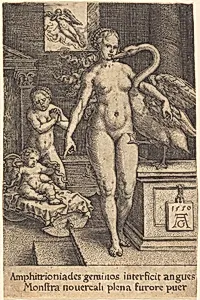
Hercules as a Child
Classification
Department
CG-E
Museum
National Gallery of Art, Washington, D.C.
Credit
Rosenwald Collection
Accession Number
1943.3.249
Rights
Public Domain
Art Historical Context
In the National Gallery of Art's Rosenwald Collection, Heinrich Aldegrever's *Hercules as a* (1550) a pivotal moment from classical mythology through the lens of Northern Renaissance printmaking. Aldegrever, a German engraver andsmith from Soest (c. 1502–1555/61), was one of theLittle Masters," renowned for virtuosic small-scale engrav. This print, classified in the CG-E department, exemplifies his skill in rendering intricate details on a modest format, making complex narratives accessible to a wide audience. The image likely depicts the infant Hercules strangling the serpents sent by Hera to kill him—a testament to his divine strength and destiny as a hero. Created amid the Protestant Reformation in the Holy Roman Empire, Aldegrever's work blended pagan mythology with the era's fascination for antiquity, influenced by masters like Albrecht Dürer. Prints like this were revolutionary, serving as affordable art, devotional aids, and vehicles for humanist ideas, circulating stories from Ovid and beyond. Aldegrever's precise line work and balanced compositions highlight the technical prowess of 16th-century German engraving, bridging Gothic traditions and emerging Mannerism. For visitors, this piece invites reflection on enduring themes of heroism and resilience, preserved beautifully in the National Gallery's holdings.
About the Artist
Heinrich Aldegrever · 1502–1561
Heinrich Aldegrever, born in 1502 in Paderborn, Westphalia, to parents Herman and Katherine Trippenmeker—a family of clog-makers known by the dialect name Trippenmecker—emerged as a multifaceted artist in the German Renaissance. His early training remains undocumented, though he likely apprenticed in a Soest goldsmith's workshop after relocating there around 1525, where he joined the painters' gui...